Showing posts with label translation. Show all posts

Thursday, September 17, 2009

Duel in translation

Because of blogging on geek feminism, BlogHer, and Hack Ability, and doing a bunch of things at work, I haven't said much here. It's been weeks of verbal, verbal verbal, blogging and coding and talking. The feeling of too much looking at code is a lot like the feeling of having my head in poetry. It's hard to come out of it and be articulate like a conversational human being again. It's divine madness hanging out with the muses.

Have some poems with my translations!

From Cortejo y Epinicio
David Rosenmann-Taub (b. 1927)
1949


XXXVII
El Combate

"¿Hacer?", me retorcía el Poderosos:
"autodefé de trámites lacayos,
amolando cilicios,
acuso la nostalgia del bozal."

"¡Hacer!", blandí, de pie. Larvas... Rivales
nieblas — andamios — en los yermos: una
luz rededora decisivamente
nutría y desmigaba.


Rosenman-Taub compacts these poems with precision - but with precise attention to ambiguities and broad meanings. I interpret this poem as an internal and external battle, a response to power, a battle about action. To make, to act, to do. Action? or Action! All came to mind to translate "Hacer!" In one mood, the poem comes out like this:

Duel

"To do?" Power wrung from me:
"Auto de fé of bootlicking bureacracy,
itching prickle of hair shirts;
I blame nostalgia for the leash."

"To do!" I blare, standing tall.
Mists - scaffoldings - in the wastelands, one
encompassing light critically
nurtured and eroded.

If you grant that is a possible interpretation of the poem, what would you say it means? What is its feeling? What is opposed to what? What relationship do those two verses, those two stances, have to each other? Are they either/or? Are they one in response to another?

Rosenman-Taub's poems are puzzles, cryptograms, circular ruins. They itch at me. The language sticks into itself, words interfacing uncomfortably with each other, like burrs. The language of a mad philosopher-poet. It's a How to Think manual, but not for Dummies. As some difficult novels function to teach the reader how to read (suspiciously, and circularly) these difficult short poems teach the poet all that difficulty in an alchemical crucible. Playfully - but dead serious.

Here are two more translations of a single poem by him, "Jerarquía". They're fun!

It is a mistake when translators translate an obscure word in one language to make it easier to understand in a new. I try to go with my judgement of how awkward, hard, stuck up, dusty, a word is. caliginous for example. I let it stand in this bullfight poem.

VIII

En el poniente de pardos vallados,
de sobaquillo y verónica de oro,
juegan el hombre y la parca: embrocados,
derivan: cuadran faena. El tesoro,

caliginoso cabestre, se oculta
de la destreza de tules solares:
risco de fauces de jade: sepulta
los quioscos gilvos. La parca ¡No pares!

hace ondular sobre los inmolados
novillos. Cómplice de acantilados
cuernos, ¡No pares! se trasvina, sigue

y sigue... El hombre a las landas del cielo
ha escudriñado con garfio gemelo.
Ya no se sabe quién es quien persigue.


Like I said, a metaphysical bullfight. What a poem, interrupting itself!

VIII

In the west wind of corralled dun bulls,
of cape-sweep and stylish lance-stab, golden,
man and fate are playing: horn-tangled,
they shift meaning: dance formal faena. The best,

caliginous maverick, half-hidden
from the dexterity of sunlight lace:
rock-crag jade jaws: he entombs
the gilted grandstands. Fate - Don't stop! -

ripples waving over the sacrificial
yearling bulls. Conspirator of cliff-edge
horns - Don't stop! - transcending, on

and on... The man come to heaven's prairies
has skewered all with twinned horn;
Now who knows who's chasing who?


It's impossible to translate a poem like this literally and not screw it up. You have to know that it means something, settle on a meaning, on meanings battling, and hover over those meanings. "Don't stop!" set off from the action and repeated I think here is perfectly timed, an abruption of what the poem means and who is speaking or thinking. Who is saying don't stop? to who? We feel the audience - we are the audience of the bullfight and the dance, the fight is between the poet and the text, or the poet and the poem. Or the author exhorts us, familiarly - go on! Don't stop! Or any number of any other beautiful air-castles of meaning. The poem turns midway through from a poem about a bullfight to a poem about ways of thinking and reasoning.

Digg this

Friday, November 28, 2008

Delmira Agustini

Delmira Agustini (1886-1914)

Agustini was part of the Uruguayan generation of 1900 along with María Eugenia Vaz Ferreira, Julio Herrera y Reissig, Leopoldo Lugones, and Rubén Darío; and was also considered part of the "generation of the Río de la Plata" of 1910-1920 (Camps 6). She was close to the Argentine writer Manuel Ugarte and to María Eugenia Vaz Ferreira. Early in her career, poets and critics like Juan Zorrilla de San Martin and Carlos Vaz Ferreira called her "The baby muse" and played up the image of her as a chaste, virginal child. Later, scandal accompanied her image as an artist and poet, her bohemian life and her tragic murder.

In 1902 Agustini began writing a regular column, “La legión etérea,” for La Alborada, a popular weekly journal, under the pseudonym “Joujou” (Rosenbaum 67-68). The column focused on prominent artistic and literary women.

She was considered a modernista, though a maverick “feminine” modernista who, outside mainstream literary circles, was one of “algunas figuras independientes . . . que introdujo una nota de honda y sensual femineidad en la poesía modernista" 'a few independent figures . . . who introduced a note of depth and sensual femininity into modernista poetry' (Henríquez Ureña 275). Other critics identify Agustini as part of a movement of women’s poetry: "It was perhaps Delmira Agustini who better represented a certain concept of feminine poetry: a poetry of passion and sensuality, a poetry written to challenge social conventions and to exalt eroticism unabashedly" (Rodriguez Monegal 1:368). Critics early in the 20th century often praise the technical perfection of her verse.


Fiera de amor


Fiera de amor, yo sufro hambre de corazones.
De palomas, de buitres, de corzos o leones,
No hay manjar que más tiente, no hay más grato sabor,
Había ya estragado mis garras y mi instinto,
Cuando erguida en la casi ultratierra de un plinto,
Me deslumbró una estatua de antiguo emperador.

Y crecí de entusiasmo; por el tronco de piedra
Ascendió mi deseo como fulmínea hiedra
Hasta el pecho, nutrido en nieve al parecer;
Y clamé al imposible corazón . . . la escultura
Su gloria custodiaba serenísima y pura,
Con la frente en Mañana y la planta en Ayer.

Perene mi deseo, en el tronco de piedra
ha quedado prendido como sangrienta hiedra;
Y desde entonces muerdo soñando un corazón
De estatua, presa suma para mi garra bella;
No es ni carne ni mármol: una pasta de estrella
Sin sangre, sin calor y sin palpitación . . .

Con la esencia de una sobrehumana pasión!


Fierce from love


Made fierce by love, I'm starving for hearts.
Pigeon, vulture, dun deer or lion,
no meat tempts me more with exotic flavors.
I'd blunted my claws and my primal drives.
Then, set up on a plinth, almost otherworldly,
a statue dazzled me–an ancient emperor.

And I fed my eagerness; over his stone body
my desire ascended like ivy lightning, sudden
up to his chest, feeding on skin like snow;
and I cried out to his unreachable heart . . . sculpture
guarding his glory, most chaste, still, and pure,
his face towards Tomorrow, feet rooted in Yesterday.

Everlasting my desire; on the stone body
I've stayed pressed like a living blood-filled vine;
And since then, dreaming, I devour
a statue's heart, prey worthy of my gorgeous claws;
it's not flesh, not marble: the stuff of stars,
without blood, heat, or heartbeat . . .

I devour it with deep, inhuman passion!


Nocturno


Engarzado en la noche el lago de tu alma,
diríase una tela de cristal y de calma
tramada por las grandes arañas del desvelo.

Nata de agua lustral en vaso de alabastros,
espejo de pureza que abrillantas los astros
y reflejas la sima de la Vida en el cielo . . .

Yo soy el cisne errante de los sangrientos rastros,
voy manchando los lagos y remontando el vuelo.


Nocturne


Lake of your soul, gem-mounted in night,
you would tell a thread of crystal and calm
spun by the huge spiders of wakeful evening.

Lustral waters born in alabaster cups,
mirror of purity where the stars shine
and reflect the abyss of Life in the heavens . . .

I am the wandering swan of bleeding trails,
I'm dirtying the lakes and soaring in flight.

Digg this

Tuesday, November 18, 2008

Translation: Mariblanca Sábas Alomá

Mariblanca Sábas Alomá (1901–1983)

Mariblanca Sábas Alomá was an Ultraist feminist Cuban writer. She was involved with the first Congreso Nacional de Mujeres in Havana in 1923. Her work was published in El Cubano Libre, Diario de Cuba, Orto and El Sol in Havana. Sábas Alomá took literature courses in Mexico and also attended Colombia University in New York and Puerto Rico. She travelled throughout South America, worked as a journalist and editor, and was politically active as a communist and feminist.

tuesday, longest day ever

In Poetisas de América, Sábas Alomá’s contemporary María Monvel, with characteristic blunt opinion, says of her:


Mariblanca comenzó escribiendo versos blancos, soñodores, llenos de ritmo, musicalidad y vulgaridad. Mariblanca cambió de filas, se pulió, se cultivó, y hoy hace campear su estandarte en las filas del más refinado ultraismo. Poeta de las revoluciones, como la uruguaya Blanca Luz Brum, Don Quijote de las ilusiones extremas, Mariblanca se ha convertido como en broma, en una notable poetisa. Es de esperar que cuando aconche un poco su absolutismo izquierdista, Mariblanca será una de las grandes poetisas americanas. (193)
Mariblanca began writing poetry that was pretty, sonorous, full of rhythm, musicality and vulgarity. Mariblanca changed her tune, became refined, cultivated, and today has raised her banner in the ranks of the most savvy ultraists. Poet of revolutions, like the Uruguayan Blanca Luz Brum, a Don Quixote of extreme illusions, Mariblanca has converted herself from a trivial writer into a notable poetess. It’s to be hoped that when her absolutist leftism settles, Mariblanca will be one of the greatest American poetesses.


Sabás Alomá’s 1920 article “Masculinismo, no. Feminismo!” was published recently in a volume of her essays, Feminismo. In 1928 she published an article in which she characterized lesbianism (“garzonismo”) as a crime against nature, encouraged by capitalism, that would disappear with the advent of true socialism; for her, feminism was in complete opposition to lesbianism (Menéndez).

Magda Portal wrote critical articles about the socially engaged vanguardist poetry of Sabas Aloma in a 1928 issue of Repertorio americano, “El nuevo poéma y su orientación hacia una estética económica” (Unruh, Performing, 176).

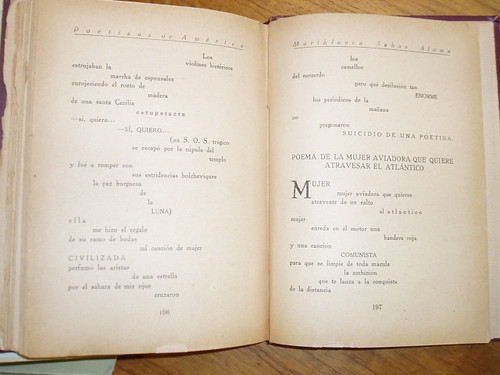
In “Poema a una mujer aviadora,” Sábas Alomá spaces words freely across the page, leaping great distances in sweeping arcs, just as the aviator would zig-zag across the Atlantic. A later poet, the Argentine writer Elvira Hernández, might be paying homage to Sábas Alomá in her long poem “Carta de viaje,” both in form and in theme. Hernández describes a flight across the Atlantic from south to north, from Latin America to Northern Europe, focusing on the dislocated state of flying, not on land, sea, or earth, detatched from terrestrial metaphor.

Juana de Ibarbourou echoes the “shout” of Sabás Alomá in her 1930 poems “El grito,” “Las olas,” and “Atlántico” in which she longs to leap the distance between the world of the real and the world of ideals.


Poema de la mujer aviadora que quiere atravesar el Atlántico

MUJER
mujer aviadora que quieres
atravesar dee un salto
el a t l á n t i c o
mujer
vereda en el motor una
bandera roja
y una canción
COMUNISTA
para que se limpie de toda macula
la ambición
que te lanza a la conquista
de la distancia
enorme
mujer
no asciendas por coqueteria
asciende porque el clamor intenso da
los hombres que sufren
t e p r e s t e s u s a l a s
mujer
tiende sobre la vastedad marina
que

S
E
P
A
R
A
dos continentes
el arco fraternal que una en un mismo
anhelo de
J U S T I C I A
a América
y a
Europa
mujer
desde una altura de 2,000 metros
deja caer sobre el mar
y sobre la tierra
L A N U E V A P A L A B R A
así veremos en la noche
un zig
zag
guiar
d e e s t r e l l a s j u b i l o s a s
mujer
esconde en la cabina de tu aeropleno el
G R I T O
– santo–y–seña de la América joven –
A N T I M P E R I A L I S M O
y clávalo
– para que toda Europa lo contemple
y
los ejércitos de
RUSIA
le hagan los saludos de ordenanza
EN LO MÁS ALTO DE LA TORRE DE EIFFEL
mujer
si tu sueño se rompe en el canto de una ola
no llegues a los dominios de lo
desconocido
rezando–padre nuestro, que estás
en los cielos
–sino regalando el oído
de los proletarios exámines
con un
– ARRIBA LOS POBRES DEL MUNDO
DE PIE LOS ESCLAVOS SIN PAN . . .


Poem of the aviator woman who would cross the Atlantic


WOMAN
woman aviator who wants
to cross in one bound
t h e a t l a n t i c
woman
in the engine falling into step with a
red flag
and a song that's
COMMUNIST
in order to cleanse everything soiled from
the ambition
that throws you at the conquest
of distance
enormous
woman
you don't ascend through coquetry
you ascend because the intense clamor of
people who suffer
l e n d s y o u w i n g s
woman
you stretch above the marine vastness
that

S
E
P
A
R
A
T
E
S
two continents
the fraternal arch that in the same
longing for
JUSTICE
for America
and for
Europe
woman
from a height of 2,000 meters
let fall across the sea
and across the land
T H E N E W W O R D
so that we'll see it in the night
a zig
zag
trail
o f j u b i l a n t c o n s t e l l a t i o n s
woman
hidden in the cabin of your airplane is the
S H O U T
– sacred–and–signal of the young America–
A N T I M P E R I A L I S T
and drive it home
– so that all Europe will see it
and
the multitudes of
RUSSIA
will make their comradely greetings the norm
ON THE HIGHEST PEAK OF THE EIFFEL TOWER
woman
if your dream breaks on the song of a wave
you won't arrive at the domains of what's
undiscovered
praying–our father, who art
in heaven
– not conforming to the rule
of the watchful proletariats
with a
RISE UP, POOR OF THE EARTH
STAND UP, SLAVES WITHOUT BREAD . . .

Digg this

Friday, November 14, 2008

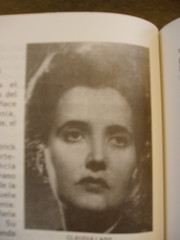
Translation: Claudia Lars

Here's my chapter on Claudia Lars. I found this a hard poem to translate. Though I could't do it justice, I enjoyed trying. Vanguardist poetry is hard, in general. I think because it is built on so much symbolism from other poems, but is trying to break free of that dependency; it feels like shorthand. Sometimes the poems I like the most, or like the most to translate, don't come out that well. Maybe it's overthinking. I'd like very much to translate her little book on Laika the cosmonaut dog.

Of course, I am especially fond of Lars because of my love of feminist science fiction. She's a little bit science-fictiony, don't you think? And this is certainly a feminist response to patriarchal poetics -- a description of "woman" in poetry, but not with the metaphors and language that describes women in terms that are disempowering. It is possibly a difficult poem for that reason too; because it is trying to evade something.

Claudia Lars


Claudia Lars (1899-1974)

Margarita del Carmen Brannon Vega is her birth name; she is also called Carmen Brannon Beers or Carmen Brannon de Samoya Chinchilla. She was born in El Salvador. She studied and lived in the United States, Mexico, Costa Rica, and Guatemala.

Her early work in the 1920s and 1930s was compared to Agustini, Mistral, Storni, and Ibarbourou. She lists as her early influences Cervantes, Fray Luís de León, Lope de Vega, Quevedo, Góngora, Shakespeare, Wordsworth, Burns, Coleridge, Whitman, Poe, Dickinson, Shelley, Byron, Yeats, Blake, and Darío (Barraza 142). Critics called her a lyrical postmodernist. Later, she was considered part of the Vanguard, writing in both formal and free verse.

Her books include Tristes mirajes (1916); Estrellas en el pozo (1934), and Canción redonda (1937). She also wrote poems and books for children, sonnets to famous women writers of many countries, and, later in the 20th century, she wrote a poem cycle on the cosmonauts of the United States and Russia–including the dog Laika.

“Dibujo” sets out a bold feminist vision of the future. The poem’s woman “que llega,” who’s coming, arriving now, or will soon arrive, transcends the usual gendered metaphors. Her ascension is not like flight, and not like the growing of a plant that is rooted in the earth. Instead, Lars describes a woman who stands up, who has agency and raises herself up with all her intelligence and power.


Dibujo de la mujer que llega

En el lodo empinada,
No como el tallo de la flor
y el ansia de la mariposa . . .
Sin raíces ni juegos:
más recta, más segura
y más libre.

Conocedora de la sombra y de la espina,
Con el milagro levantado
en los brazos triunfantes.
Con la barrera y el abismo
debajo de su salto.

Dueña absoluta de su carne
para volverla centro del espíritu:
vaso de lo celeste,
domus áurea,
gleba donde se yerguen, en un brote,
la mazorca y el nardo.

Olvidada la sonrisa de Gioconda,
Roto el embrujo de los siglos,
Vencedora de miedos.
Clara y desnuda bajo el día limpio.

Amante inigualable
en ejercicio de un amor tan alto
que hoy ninguno adivina.
Dulce,
con filtrada dulzura
que no daña ni embriaga a quien la prueba.

Maternal todavía,
sin la caricia que detiene el vuelo,
ni ternuras que cercan,
ni mezquinas daciones que se cobran.

Pionera de las nubes.
Guía del laberinto.
Tejedora de vendas y de cantos.
Sin más adorno que su sencillez.

Se levanta del polvo . . .
No como el tallo de la flor
que es apenas belleza.


Sketch of the woman of the future


Standing tall in the mud.
Not like the flower's stalk
and butterfly’s desire . . .
No roots, no flitting,
more erect, more sure
and more free.

Knower of shadow and thorn,
With miracle held high
in her triumphant arms.
With obstacle and abyss.
beneath her stride.

Absolute queen of her flesh
returned to the center of her spirit:
vessel of the celestial,
domus aurea, home of the golden;
clod where shoots burst forth into
maize and fragrant flower.

Forgotten: the Mona Lisa's smile.
Broken: the spell of centuries.
Conquered: the fears.
Bright and naked in the pure, clean day.

Unequalled lover
in enjoyment of a love so lofty
that no one today could predict it.
Sweet,
with controlled sweetness
that doesn't hurt or intoxicate the drinker.

Maternal still,
without the caress that holds back flight
nor tenderness that traps,
nor submission and giving in, that little by little, smothers.

Pioneer of the clouds.
Guide to the labyrinth.
Weaver of veil and song.
Adorned only in her simplicity.

She stands up from the dust . . .
Not like the flowering stem
that’s not so beautiful.

Digg this

Thursday, November 13, 2008

Translation: Emilia Bernal

Here's yet another section from my anthology! Enjoy. The poem about the rose is kind of naughty - just thought I'd point that out in case you're not naturally dirty-minded.

Emilia Bernal (1884-1964)

Emilia Bernal de Agüero was born in Cuba, and lived in Ecuador, Perú, Bolivia, Chile, and New York. She was married young and had four children before 1908. She taught college literature. In 1909 she separated from her husband, and began publishing in 1910. After her divorce, she joined the Cuban diplomatic staff. She was known as a rebel, non-conformist, and political writer (Vega Ceballos). She wrote for La Nación, Bohemia, Social, and El Fígaro (Biblioteca Virtual Miguel de Cervantes).

The Basque writer Llorenç Villalonga, author of the play Silvia Ocampo (1935), wrote the novel Fedre and the first part of Madame Dillon based on his relationship with Bernal (Pomar).

Emilia Bernal

Henríquez Ureña mentions Bernal as a modernist and follower of Martí in his history of modernismo. Emilia Bernal translated from Catalan, Portuguese, and other languages into Spanish; her translation work includes a book of poems by Rosalia del Castro.

Her publications include: Alma Errante, poems (1916); Cómo los pájaros! poems and translations (1923); Layka Froyka, autobiography (1925); Los nuevos motivos, 1925; Exaltación (1934); Poetas catalanes de hoy, translations (1927); Cuestiones cubanas para América, political essays, (1928); and Negro (1938).

Though her work is often spoken of as personal, modernista, or lyrical, Bernal was engaged in politics for much of her life and read a series of lectures in Spain, Portugal, and elsewhere on Cuban and United States politics (Davies 22). Along with many other feminists such as María Luisa Milanés, she allied herself with anti-racist movements and described herself as a sister-in-arms of enslaved people – going so far as to declare that all women were slaves because of the lack of female suffrage and other factors (Davies 57).

Anderson-Imbert said of her: "Tender, ardent, intuitive, was capable of denying these qualities in herself in order to complicate sounds which brought her close to a poetry which, under the heading ‘abnormality’ will be studied in the second part of this panorama. Those who remain, then, are Cubans of the ‘abnormality’–Mariano Brull, Navarro Luna, and others . . ." (337). What Anderson-Imbert calls “the abnormality” is the "vanguardist subversion" against modernismo.

Bernal is noticably absent from many biographical dictionaries of Latin American writers.

“Pedrería” plays with modernista color symbolism; the gems represent ideals of perfect beauty. Rather than setting a scene of fantasy to which the soul of the poet is transported, or a situation of transmutation to a plane of ideals, Bernal engages sensually and physically with the perfect beauty of the gems. “A una rosa” (1916) is a poem in sexta rima with a scandalous subtext: the rose and its stalk are limp and drooping, while the poet wishes and imagines that her efforts will make it stand erect again. “Hierro” is from the México chapter of Bernal’s 1937 book América. There is an earlier version of the poem from 1925, but I have not yet found it. In “Hierro,” Bernal ventures into the realm of free verse and presents a vision of industrialization, and Mexico, as boldly but perturbingly masculine.

Pedrería


Ámbar. Mármol. Zafir. La algarabía
de un cofre de fakir. Que se aproveche
de tanto encanto mi osadía. Eche
a revolver en él la mano mía.

Alabastro y azur. Sangre del día.
Piedras a granel. Rosas de leche.
Carcajadas de luz. Mi afán estreche
y agite la ofuscante pedrería.

Mar. Cielo. ¡Sol, entre mis brazos!
¡Fuego
de los claros diamantes con que juego!
Malquitas, topacios. ¡Serpentinas

de centelleos en mis manos! ¡Presas
en los dedos guirnaldas de turquesas,
lapislázuli, jade, aguas marinas!


Jewels


Amber. Marble. Sapphire. The jingling babble
of magic treasure. May my bold desires
make the most of such enchantment. Let me
stir them around with my hand.

Alabaster and azure. Day's blood.
Stones in a heap. Roses made of milk.
Great laughter of light. My longing grasps
and tumbles the precious jewels.

Sea. Sky. Sun in my arms!
Fire
of bright diamonds playing!
Malachite, topaz. Serpentine ribbons
sparkling in my hands! Caught
in my fingers, wreaths of turquoise,
lapis lazuli, jade, aquamarine!


A una rosa


O rosa, ¡rosa mía! que ayer lozana fuiste,
por qué doblas ahora lacia, debil y triste,
tus pétalos marchitos, tu cáliz sin verdor.
¿Le cuentas a la tierra tus dulces remembranzas
como en largo secreto sus muertas esperanzas
la moribunda virgen le cuenta al confesor?

Pensando en lo que fuiste y al ver cómo feneces,
quisiera alzar el tallo en donde languideces,
tornarte la frescura, la belleza, el color,
volverte en un suspiro tu aliento perfumado,
acercarte mis labios y a un beso prolongado
prender en ti, de nuevo, suavísimo el calor.


To a rose


Oh rose, rose of mine! that once sprang sprightly up,
why do you bend double, flaccid, weak and sad,
your petals withered, your once-green calyx pale?
Do you tell the earth the sweetness of your past,
like the long secret story of dead hopes
a dying virgin whispers to her priest?

Thinking on what was was, and to see how you decline,
I'd wish to raise the stalk on which you languish,
to give fresh strength to you; beauty, color;
to return, with a sigh, your perfumed breath
to bring you to my lips and in a long, long kiss
press upon you new, most softly, heat and fire.


Hierro


¡Un hombre de hierro!
De hierro las carnes del pecho invencible.
De hierro los bíceps y tríceps del brazo que erecta triunfante ademán.
Las manos de hierro y el vientre.
Y los muslos columnas potentes de hierro, y las piernas,
cual zócalos bravos sostenes de aquel formidable titán,
con el pie clavado en la tierra apretando en los dedos de garra
las raíces del árbol que arranca del bíblico Adán

De hierro los ojos.
De hierro los dientes.
De hierro el cerebro, los pulmones y el corazón,
los riñones, el bazo y el sexo.
Por fuera y por dentro un hombre completo de hierro.
¡La fuerza!
La fuerza más grande que el tiempo a la vida ha lanzado
es su encarnación.


Iron


A man of iron!
Iron the flesh of his invincible chest.
Iron his biceps and triceps, his arm raised in triumphant sign.
His hands of iron and his belly.
And his thighs potent columns of iron, and his calves,
brave pedestals sustaining that formidible Titan,
with his foot nailed to the earth, with clawed fingers he seizes
the roots of the tree from the Biblical Adam.

Iron his eyes.
Iron his teeth.
Iron his brain, his lungs and heart,
his kidneys, spleen, and sex.
Inside and out a man completely made of iron.
Strength!
The greatest strength that time has launched
is his incarnation.

Digg this

Sunday, November 09, 2008

Translation: Jesusa Laparra (1820-1887)

Here's another chapter of my thesis. I hope someone enjoys this or finds it useful! Someday I'd love to spend a few years traveling around to different libraries in Spanish America looking up old issues of these journals, finding and collecting and translating poems.

Jesusa Laparra (1820-1887)

Jesusa Laparra and her sister Vicenta, originally from Guatemala, founded and edited a women's journal, La Voz de la Mujer, in the mid-19th century; started a literary magazine, El Ideal; and wrote for other progressive and feminist journals. Jesusa wrote poetry on mystic, romantic, and religious themes. Her books include Ensayos poéticos (1854) and Ensueños de la mente (1884) (Méndez de la Vega).

Her sister, Vicenta Laparra de la Cerda (1831-1905) was a poet, playwright, and essayist on the rights of women. With Jesusa, she published several journals. A mother of eight children, Vicenta was known as a singer and soloist, collaborating and performing with other artists for benefit of the Teatro Carrera. She is also known as the creator and founder of the Teatro Nacional in Guatemala. Her political essays in El Ideal resulted in her being forced into exile from Guatemala to Mexico, where she founded a school for girls. Vicenta published books of poems, including Poesia and Tempestades del alma; plays such as "La hija maldita," "Los lazos del crimen," and "El ángel caído;" the novel La Calumnía (1894); and other works of history and literary criticism.

The Laparra sisters and Vicenta's husband went into exile again, from Mexico to El Salvador and Costa Rica, where they continued their commitment to teaching women "self-improvement." Jesusa and her sister fought not only for the rights of women but for the rights of Native Americans. Though she was partially paralyzed and in a wheelchair for many years, known as “La poetisa cautiva” or 'The Captive Poetess,' she continued her careers of writing, teaching, and public speaking (Laparra de la Cerda).

The Laparra sisters' political and literary circle included María Cruz, Elisa Monge, J. Adelaida Chéves and her sisters, Dolores Montenegro y Méndez, Lola Montenegro, and Carmen P. de Silva. There might be connections between the Laparra sisters and another set of interesting sisters: the Guatemalan poets and editors Jenny, Blanca, and María Granados, who wrote for El Grito del Pueblo and who founded the magazine Espigas Sueltas in 1929.

Many, in fact most, Latin American anthologies and biographical dictionaries that I consulted did not include information on the Laparra sisters despite their extensive international publishing and editing history. A small selection of their verses can be found in Acuña Hernández’s Antología de poetas guatemaltecos (1972).

“La risa” (1884) is written in redondillas, that is, rhymed quartets of octosyllabic lines de arte menor. It describes the emotions behind a laugh of despair and the impossibility of communicating grief and pain in words.


La Risa


Hay una risa sin nombre,
sólo de Dios comprendida
risa sin placer ni vida,
risa de negro dolor;
funeraria, envenenada,
más dolorosa que el llanto,
porque es engañoso manto
donde se oculta el dolor.

Risa que, al salir del labio,
para animar el semblante,
deja una huella punzante
de amargura y sinsabor.
Infeliz desventurado,
es aquel que así se ría,
que esa risa es de agonía,
es de muerte, es de pavor.

Como el esfuerzo supremo
que estremece al moribundo,
al desprenderse del mundo
para nunca más tornar:
dilatada la pupila,
ríe con indiferencia,
despreciando la existencia
que por siempre va a dejar.

Así es la risa funesta
de un corazón desdichado
por un dolor desgarrado
que no se puede arrancar.
Lleva la muerte consigo,
y ríe sin esperanza,
porque nada, nada alcanza
su martirio a disipar. The laugh


There's a laugh that can't be named,
that only God understands;
a laugh without life or joy,
a laugh of black sorrow;
funerary, dripping venom,
more painful than a lament,
because it's a cloak of deceit
to hide pain and grief.

Laugh that, as it leaves your lips
to liven your face,
leaves a heartrending trail
of bitterness and discontent.
Unlucky devil,
that's why you laugh;
it's a laugh of agony,
of death, of terror.

Like the last throes
that shake the dying
when they give up this world
never to return;
eyes open and staring,
you laugh with indifference,
despising an existence
you're leaving forever.

That's how it is: the fatal laugh
of a heart undone
by clawing pain
that can't be rooted out.
You endure your own death,
and you laugh without hope,
because nothing–nothing could match
or dispel your martyrdom.


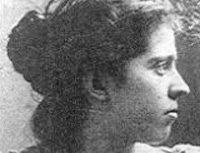
Photo of Vicenta Laparra de la Cerda - Jesusa's sister

Digg this

Tuesday, November 04, 2008

Translation: Feminismo, by Alfredo Arteaga

This poem is by the Argentinian writer Alfredo Arteaga and was published in 1917 in Antología Contemporánea de poetas argentinos. It is guaranteed to annoy. I stuck it in my anthology of women poets, in Appendix B. This is what our poetisas had to deal with -- damning praise, the gist of which is, "Shut up, look pretty, quit writing poetry!"

Don't be fooled; it is not a feminist poem. It's a critique of the feminists of 1917, who were fighting for rights, for education, for the vote, and to be taken seriously as writers. It's a great example of how feminization can be used by patriarchy to infantalize and silence women, to deny them agency.


Feminismo


Porque es vuestro, mujeres, el encanto
que ilumina y perfuma la existencia;
porque vertéis amor–eterna esencia
de toda la alegría y todo el llanto;
porque, al pasar vosotras, los más nobles
y fuertes corazones se estremecen
y juncos, tiemblan los que fueron robles;
porque gemas y flores nos parecen
creadas sólo para vuestro lujo;
porque no hay en el mundo quien ejerza
función sagrada o soberano imperio,
sin estar sometido a vuestro influjo;
porque dáis, aunque débiles, la fuerza
que penetra al abismo del misterio
y sube del ensueño hasta la cumbre;
porque la irradiación de vuestra gracia
a todas las tinieblas presta lumbre,
y nos brindáis un bálsamo divino
para cerrar heridas del destino;
porque formáis la excelsa aristocracia
de virtud, de bondad y de belleza,
a la que sólo el vil infiere agravios;
porque sóis la suprema fortaleza
(que dijo Salomón en sus Proverbios)
ante la cual se humillan los soberbios;
porque son siempre necios los más sabios,
si en vuestra copa no han bebido un día
la ignorante, esencial sabiduria;
porque es vuestra la luz de las leyendas,
el alma musical de los cantares
y el fecundo calor de los hogares;
porque recibe Dios nuestras ofrendas
con agrado mayor, si vuestras manos
o labios la elevan; porque el cielo
os desterró para adornar la tierra
y aquí extender de la ilusión el velo;
en fin, porque, entre títulos humanos,
os pertenece el título que encierra
toda la majestad y la dulzura –
ese nombre de madre–¡oh bellos seres
que derramáis primaveral frescura
en los tiempos más foscos de la historia
y que santificáis nuestros placeres,
contentaos por siempre con la gloria
y con la suavidad de ser mujeres!


Feminism


Because it's yours, women, the enchantment
that illuminates & perfumes existence;
because you shed love–eternal essence
of all happiness and all sorrow;
because, on meeting you, the noblest,
strongest hearts tremble
and oaks turn to shivering reeds;
because to us you seem to be gems and flowers
created only for our luxury and enjoyment;
because there isn't anything in the world that exercises
sacred function or imperial sovereignity
without being submitted to your influence;
because, though weak, you give strength
that penetrates the abyss of mystery
and you mount in dreams to the summits of mountains . . .
Because the radiation of your grace
brings hunger to all that’s dark and and hidden
and you bring us a divine balm
to heal the wounds of fate:
because you form the highest aristocracy
of virtue, of kindness, and of beauty
to which only the evil give offense;
because you are the supreme fortitude
(just as Solomon said in Proverbs)
before which soveriegns make themselves humble;
because even the wise are most foolish
if they never drink, from your cup,
your naive, essential wisdom:
because it's yours, the light of legends,
the musical soul of the singers
and the fertile heat of the hearths;
because God hears your prayers
with greater amiability if your hands
or lips lift them to heaven;
because heaven exiled you to adorn the earth
and extends here the veil of illusion;
in fin, because, among human titles
you have the title that encompasses
all majesty and sweetness,
this name of mother–oh lovely beings
that spill over with primeval freshness
in the greatest focal points of history;
you who sanctify our pleasures,
content yourselves for always with the glory
and the softness of being women!

Digg this

Monday, November 03, 2008

Translation: María Luisa Milanés (1893-1919)

María Luisa Milanés was an ardent feminist and Cuban nationalist who killed herself in part because of an unhappy marriage (Davies 58). She wrote poems that were deep critiques of patriarchal culture and that were expressions of solidarity with other women and all oppressed people.

Her poems were sometimes published under the pseudonym Liana de Lux. Her passions were philosophy, music, and literature. Her works include Autobiografía, published though unfinished. She destroyed many of her own poems and essays before her death. Amado Nervo was said to be her favorite poet and a great influence on her work.
She read French, English, and Latin, writing in and translating from French, Spanish, and English, publishing in the journal Orto (Fajardo). A 1920 volume of Orto gathered a selection of her verses and was dedicated to her memory (Lizaso and Fernández de Castro 299).


Hago como Spártaco


Ya decidí, me voy, rompo los lazos
que me unen a la vida y a sus penas.
Hago como Spártaco;
me yergo destrozando las cadenas
que mi exisitir tenían entristecido,
miro al mañana y al ayer y clamo:
¡Para mayores cosas he nacido
que para ser esclava y tener amo!

El mundo es amo vil; enloda, ultraja,
apresa, embota, empequeñece, baja
todo nivel moral; su hipocresía
hace rastrera el alma más bravia.
¡Y ante el cieno y la baba, ante las penas
rompo, como Spártaco, mis cadenas! I’ll do what Spartacus did


I've decided: I'll go, breaking the ties
that bind me to life and its sorrows.
I'll do what Spartacus did;
I'll stand tall to destroy the chains
that have saddened my being,
I'll look towards morning and the past and declaim:
I was born for greater things
than being a slave and having a master!

The world is a vile master; filth, insult,
snare, mind-numbing, soul-narrowing, below
all moral standards; its hypocrisy
makes the bravest soul despicable.
And considering the mud and slime, considering sorrow,
I break, like Spartacus, my chains!


No puedo comprender . . .


Me abisma no entender, bello Narciso,
la ingenua admiración que te arrebata
y te fascina en la onda azul y plata . . .
Claro, que para ti es un paraíso
mirar tus ojos bellos y tu boca,
tu sonrisa, tu frente y tu figura
llena de majestad y de dulzura . . .
Pero ¿no piensas que haya algo de bueno
que distraiga tus ojos y tu mente,
fije más alto tu mirar sereno
y entretenga tus horas dulcemente?
¡Quisiera comprender mi alma sencilla
la perfecta hermosura de tu frente,
donde jamás el pensamiento brilla!


I just don’t get it . . .


Lovely Narcissus, I'm afraid I don't understand
the naive admiration that grips
you bewitched in the blue and silver wave . . .
Sure, for you it's Paradise
to look into your own beautiful eyes and your mouth,
your smile, your brow and your figure
full of majesty and sweetness . . .
But don't you think there's something better
that might amuse your eyes and mind,
might direct your calm gaze to something higher
and fill the hours with sweetness?
My simple soul longs to understand
the perfect beauty of your brow,
where no thought ever sparks!

Digg this

Sunday, November 02, 2008

Translations: Bolivian poet Adela Zamudio (1854-1928)

Here's another chapter from my (unpublished) anthology, Spanish American Women Poets (1880-1930).

Adela Zamudio was a Bolivian poet, essayist, novelist, teacher, and school director. She was also an activist and an advocate of women's higher education. In her early years, her poems were published under the pseudonym "Soledad" (Aguirre Lavayen 12). Throughout her life, well into her sixties, Zamudio fought for divorce laws, secularization, women's labor movements, and other feminist liberal causes. She was also a painter, though most of her paintings are lost. Zamudio wrote a long narrative poem, "Loca de hierro" 'Iron madwoman.' She was one of the founding members of Feminiflor, a Bolivian feminist magazine.

Her publications include: Ensayos poéticos (1887); Ensayos politicos (1887); Intimas (1912); Peregrinando (1912); Ráfagas (1912); and Cuentos breves (1921). Her books were published in Bolivia, Paris, and Buenos Aires. Íntimas was a romantic epistolary novel about and for women, meant to expose the hypocrisy of the upper classes (García Pabon vii).

Her poems, romanticist and controversial, were called "virile" and "rationally masculine" by her contemporaries; they considered her a "mujer-macho" (Cajías Villa Gómez 38). She read and admired Byron, de Musset, Becquer, José Zorrilla, and José Espronceda. The all-male La Paz Literary Circle, who considered themselves to be romanticists, elected her an honorary member in 1888. An entry in the Diccionario de Mujeres Celebres of 1959 lists her as a leader of the women poets and novelists of Bolivia, who included: Hercilia Fernández de Mujía ("la ciega Mujía"), Lindaura Anzoátegui, Mercedes Belzu, Sara Ugarte, and Amelia Guijarro. In 1926 she was given a medal by the president of Bolivia (Sáinz de Roblez 1200). October 11th, her birthday, is Bolivian Women's Day.

There are biographies of Zamudio written by Gabriela de Villarreal, Alfonsina Paredes, Augusto Guzmán, and Sonia Montaño.

Much of her work remains unpublished.

She compiled a spelling book in Quechua for use in schools, and composed many poems in Quechua, among them “Wiñaypaj Wiñayninkama” 'Para siempre / Forever' (Taborga de Villarroel 181). Her translation of the poem into Spanish puts it into octosyllabic lines, a romance de arte menor. I have translated it from Spanish. Though I do not know Quechua, I include the original here because it was useful to refer to the word patterns. For example, the original used repetition in a way that the Spanish version does not duplicate.

"Nacer Hombre," her most famous short poem, was published in 1887. It is a poem “pie quebrado,” ‘broken meter,’ with verses of octosyllabic lines and one line shortened to four or five syllables, and thus is de arte menor, in a popular form for poetry and folk song.


Nacer Hombre


Cuánto trabajo ella pasa
Por corregir la torpeza
De su esposo, y en la casa,
(Permitidme que me asombre).
Tan inepto como fatuo,
Sigue él siendo la cabeza,
Porque es hombre!

Si algunos versos escribe,
De alguno esos versos son,
Que ella sólo los suscribe.
(Permitidme que me asombre).
Si ese alguno no es poeta,
Por qué tal suposición
Porque es hombre!

Una mujer superior
En elecciones no vota,
Y vota el pillo peor.
(Permitidme que me asombre).
Con tal que aprenda a firmar
Puede votar un idiota,
Porque es hombre!

El se abate y bebe o juega.
En un revés de la suerte:
Ella sufre, lucha y ruega.
(Permitidme que me asombre).
Que a ella se llame el "ser débil"
Y a él se le llame el "ser fuerte."
Porque es hombre!

Ella debe perdonar
Siéndole su esposo infiel;
Pero él se puede vengar.
(Permitidme que me asombre).
En un caso semejante
Hasta puede matar él,
Porque es hombre!

Oh, mortal privilegiado,
Que de perfecto y cabal
Gozas seguro renombre!
En todo caso, para esto,
Te ha bastado
Nacer hombre.

To be born a man


She works so hard
to make up for the sloth
of her husband, and in the house
(Pardon my surprise.)
he's so inept and pompous,
that of course he's the boss
because he's a man!

If some poems get written,
a person must have written them,
but she just transcribed them.
(Pardon my surprise.)
If we're not sure who's the poet,
why assume it was him?
Because he's a man!

A smart, classy woman
can't vote in elections,
but the poorest felon can.
(Pardon my surprise.)
If he can just sign his name
even an idiot can vote
because he's a man!

He sins and drinks and gambles
and in a backwards twist of luck
she suffers, fights, and prays.
(Pardon my surprise.)
That we call her the "frail sex"
and him the "strong sex"
because he's a man!

She has to forgive him
when he's unfaithful;
but he can avenge himself.
(Pardon my surprise.)
In a similiar case
he's allowed to kill her
because he's a man!

Oh, privileged mortal
you enjoy lifelong
honor and perfect ease!
For this, to get all this,
it's enough for you
to be born a man.


Wiñaypaj wiñayninkama Para siempre


Ripunaykita yachaspa Al saber que ya te irías
Tuta-p'unchay yuyask'ani noche y día me atormento,
Sonqoy ukhu pakasqapi y sangra mi corazón
Waqaspa tukukusqani. como una sombra en tormento.

Ripuy, ripuy waj llajtaman Véte a ciudades lejanas,
Waj kausayta kausarqamuy anda a vivir otra vida,
Kaypi ñak'arisqaykita, y lo que yo haya sufrido
Chay kausaypi qonqarqamuy. olvídalo en tu existencia.

Ya(. . .)huyu, lakha phuyu Nubes negras, celajes oscuros
Uyaykipi rikukusqan se aborrascan en tu frente,
Chay shhika llakikusqayki y el dolor que he sentido
Llakiyniywan tantakusquan. brota en cascada de lágrimas.

Rejsisusqaymanta pacha Desde el día en que te vi
Wasiykita saqerpariy, nimbé mi alma en tus ojos,
Sonqoyki rumiyachispa y saturé mi corazón
Waj kausayta kausarqamuy! con unos pétalos rojos.

T'ikachus sonqoypi kanman, Si en mi pecho hubieran flores
Umphu sonqoy ch'akisqapi desde este corazón lánguido
T'kata t'akarpariyman, y marchito, alfombraría con pétalos
Purinayki yan patapi. el pasar de tu camino.

Ripuy, ripuy waj llajtaman, Véte a esas tierras lejanas,
Waj kausayta kausarqamuy, corre a vivir otra vida,
Ripuy, ripuy qonqarqamuy y sepulta en el olvido
Tukuyta kaypi kaj kama. todo cuanto aquí ha existido.


Forever


Knowing that you're leaving
torments me night and day
my heart bleeds
like a damned soul in hell.

Depart, depart for distant cities
keep on living your other life
and forget whatever I've suffered
as you enjoy existence.

Black mists, jealous clouds of darkness
obscure your brow in storm,
and the pain that I've felt
bursts forth in a torrent of tears.

Since the day I saw you
my soul glows haloed in your eyes
and my heart is full
of scarlet petals.

If in my chest there could be flowers
since this heart languishes, withering,
it would carpet with petals
the road where you walk.

Depart, depart for distant lands
go on living your other life
and bury in forgetfulness
everything that's existed here.

Digg this

Saturday, September 13, 2008

María Eugenia Vaz Ferreira: Las ondines

I promised a poem or translation this week, to balance out the political posts. Here's a couple of my translations of poems by Uruguayan poet María Eugenia Vaz Ferreira. They were published posthumously in 1924, though I am fairly sure they were published in Uruguayan or Argentinian magazines much earlier in the century. I've mentioned Vaz Ferreira a few times before in this blog, including a funny moment where I was irked at a critic: Damming with Faint Praise and No Space.

María Eugenia Vaz Ferreira

Enjoy!

This poem "Vaso Furtivo" was lovely to translate. If you read it over a few times, and let it sink in, or let yourself sink into it, you'll begin to get what Vaz Ferreira was all about.


Vaso furtivo


Por todo lo breve y frágil,
superficial, fugitivo,
por lo que no tiene bases,
argumentos ni principios;
por todo lo que es liviano,
veloz, mudable y finito;
por las volutas del humo,
por las rosas de los tirsos,
por la espuma de las olas
y las brumas del olvido . . .
por lo que les carga poco
a los pobres peregrinos
de esta trashumante tierra
grave y lunática, brindo
con palabras transitorias
y con vaporosos vinos
de burbuja centelleantes
en cristales quebradizos . . .


A quick drink


To all that's brief and fragile,
superficial, unstable,
To all that has no foundation,
logical argument or principles;
for everything imprudent,
quick, mutable, and finite;
to spirals of smoke,
to thyrsus-stemmed roses,
to foam on the waves
and forgetting's sea-mist . . .
to all that's nearly weightless
for the wandering folk
of this transient earth;
grave, moonmad, I drink to all that
with transitory words
and heady wines
sparkling with bubbles
in the most breakable glasses . . .


What could be more in tune with my own beliefs than this defiant celebration of ephemera! I worked hard to convey her floating and delicate line breaks. This translation of "Vaso furtivo" was published a couple of years ago in the journal Parthenon West.

In the next poem, I felt that Vaz Ferreira was deliberately evoking Sappho. As many of her contemporary women poets did, Vaz Ferreira wrote about the ocean and dynamic chaos as essentially feminine.

The ondines


At the shore
where the cool and silvered wave
bathes sand,
and the shining stars
flare and die
at dawn’s first rays,

from sea-foam
the ondines lightly leap,
swift curves
and forms,
ethereal dress of ocean nymphs,
fair visions.

They roll onward, clear green,
resplendent as emeralds,
the bright waters
that lend color
to their polished shoulders,
snow-white swan . . .

Some wrap themselves
in diaphanous blue mists
dressed in dawn,
others in the wind
let fly light floating gauze
the color of heaven

and the fair ones sink
svelte forms of sonorous ocean
beneath the waters,
and over the waves
their hair snakes
like rays of gold . . .


Here's the original poem:


Las ondinas


Junto a la costa
donde la arena tibia y plateada
bañan las ondas,
y los lucientes
rayos primeros de la alborada
brillan y mueren,

de entre la espuma
surgen ligeras de las ondinas
las raudas curvas
y los informes
trajes etéreos de hadas marinas,
blancas visiones.

Ruedan, verdosas,
resplandecientes como esmeraldas,
las claras gotas
que se destiñen
en la tersura de sus espaldas
de níveo cisne . . .

Unas se envuelven
las vaporosas gasas azules
del alba veste,
otras al viento
sueltan los leves florantes tules
color de cielo

y hunden las blancas
esbeltas formas del mar sonoro
bajo las aguas,
y serpentean
sobre las ondas cual rayos de oro
sus cabelleras . . .


Here is some background and commentary straight out of the enormous poetry anthology I compiled and translated a few years ago. (It was my thesis.) I had thought I'd send it around as a book proposal, and I put out some feelers. No one really wanted to take on an enormous anthology of poems of dubious copyright status from 14 different Latin American countries. Some of my translations from this book have been published in little magazines or online journals.

Vaz Ferreira was a member of the "Generación del 1900" of Uruguayan intellectuals, which included José Enrique Rodó, Julio Herrera y Reissig, Ernestina Méndez Reissig de Narvaja, Florencio Sánchez, Samuel Blixen, Alberto Nin Frias, Horacio Quiroga, and Carlos Reyles (Verani 9). She began publishing in 1894. After her illness and death in 1924, her brother, who published her book, La isla de los cánticos, downplayed the friendship between María Eugenia and Delmira Agustini. In 1959, her unpublished poems were printed as La otra isla de los cánticos.

Biographical notes on Vaz Ferreira often paint her as a frail, waiflike young maiden with a posthumous "slim volume of poems" who had a tragic illness before her early death (Jacquez Wieser 8). Her illness is sometimes alluded to as mental: Sidonia Rosenbaum implies that Vaz Ferreira, embittered by Delmira Agustini’s fame, lost her mind because of jealousy and a combination of caprice and frustrated, “sterile” sexuality (50). However, other sources emphasize her positive, charismatic qualities as a rebel, speaking of her literary and intellectual influence, her fondness for wearing men's clothes, her shocking bohemian manners, and her notorious love of practical jokes. She was the first woman in Uruguay to fly in an airplane, in 1914, at the Fiesta Aérea, a public event. Juan Carlos Legido describes her as one of the most cultured, sure of herself, famous, and popular women in Montevideo’s social circles (Legido 6). She was a literature professor at the Women's University of Montevideo, along with Dr. Clotilde Luisi. Vaz Ferreira was also a dramatist, composer and pianist. Her works were often performed at the Teatro Solís (Rubenstein Moreira 12). Vaz Ferreira was especially fond of Heine and other German poets and philosophers.

The critic Alberto Zum Felde counted Vaz Fereirra among modernista writers, influenced by the Mexican writers Salvador Díaz Mirón and Manuel Gutiérrez Nájera (Rubenstein Moriera 46). Anderson-Imbert, in Spanish American Literature, refers to her as "the nucleus of Uruguayan poetry" and of modernismo; then he calls her "a solitary voice, solemnly religious, although capable of creating sharp images on a high level" and goes on to discuss Julio Herrera y Reissig, "not a great poet . . ." for several pages. (Andersen-Imbert 279). The general pattern is for literary historians to call Vaz Ferreira’s work brilliant, and then to pay more attention to the work of poets who are men.
With typical blunt condescension, María Monvel says of Vaz Ferreira:

Interesante "caso" de mujer, de letras, esta uruguayana, que a pesar de haber nacido en 1880, tiene en sus versos todo el acento libre de la mujer nacida en pleno siglo veinte. Gran poeta lírico, con algo de reflexivo y meditativo a la vez, esta mujer es uno de los más finos cantores que ha tenido América, y tal vez es su influencia la única perceptible en Delmira Agustini, que la superó en pasión y en arrebato lírico, pero no en cultura y sensibilidad. (Monvel 63)
Interesting “case” of a woman of letters, this Uruguayan, who despite the burden of being born in 1880, has in her verses all the free tone of a woman born right in the 20th century. A great lyric poet, with something of reflexivity and meditativeness at the same time, this woman is one of the finest poets that America has had, and perhaps her influence is the only one perceptible in Delmira Agustini, who surpasses her in passion and in going overboard with lyricism, but not does not surpass her in culture or sensitivity.

My translation of the title of “Vaso furtivo” was a difficult choice. The poem is toasting and drinking to impermancence, lightness, madness, surfaces and illusion. “Sly toast” does not work in English, and “Furtive glass” does not convey the meaning of a toast. The poem itself celebrates qualities that have traditionally been attributed to women. Considered in this light, it is a radical feminist aesthetic statement. “Las ondinas,” a poem about the beauty of ocean waves at dawn, emphasizes feminine beauty, impermanence, and dynamic movement; Vaz Ferreira’s poems often celebrate an ethereal world of ideal beauty, writing modernista aesthetics from the viewpoint of a powerful woman, as in her poem “Yo soy la Diosa de las azules, diáfanas calmas” ‘I am the Goddess of all blue, diaphanous calm” (Vaz Ferreira, Otra isla, 57-58).


Digg this

Tuesday, April 08, 2008

Carmen Berenguer wins Ibero-American Pablo Neruda Poetry Prize

IMG_0071.JPG

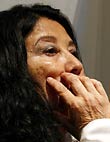
Happy Poetry Month! Congratulations to Carmen Berenguer who has won the 2008 Premio Iberoamericana de Poesía Pablo Neruda.

I am very happy for her!

And for everyone who will now read her marvelous poems!

It makes me extremely happy that work so radical, experimental, feminist, and wild, has been recognized and honored.


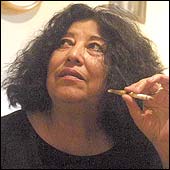
carmen berenguer

"Es una sorpresa por la poesía que yo hago, que de pronto puede ponerle trabas al entendimiento y al sentimiento. Mi poesía es sonora, interna, musical, digo cosas increíbles", comenta. "Soy una mujer combativa, vengo de los conventillos, de la pensión y esos argumentos hicieron que me fijara en las injusticias", agrega.

*
It's a surprise because of the poetry I write, that can suddenly put up blocks to understanding and feeling. My poetry is echoing, internal, musical, I say unbelievable things. I'm a fighting woman, I come from the projects, from poor neighborhoods, and that background fixed my thoughts on injustice.


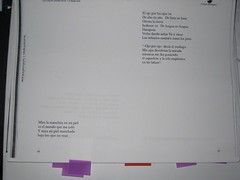
Berenguer often breaks words and form, with poem titles at the bottom of pages or strangely broken across two pages, like this:


IMG_0064.JPG

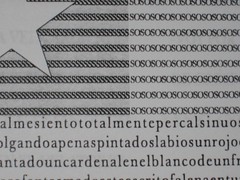
and she ranges into concrete poems in her early work such as Bobby Sand desfallece en el muro as well as in later work such as the poem typeset to look like the Chilean flag. You can see a glimpse of that poem above.

I have translated some of her work over the last few years.

So far, I have spent the most time reading A media asta and La gran hablada. While I love her short poems, I am most fond of her longer work which sprawls and rants and sobs and screams across the page, long poems that build me up to a peak of understanding. It is not "leaping poetry" in the way that Bly meant, with graceful elisions. It is broken, unclear, obstructive, difficult, obstreporous. And, that is suitable, that is what is right, when you write about political violence, about gendered violence, about bodies, oppression, about Chile under Pinochet, as Berenguer does.


Carmen Berenguer

That is what I love best in poetry. I love when it has physicality, when it fights with sense, when it has elbows that stick out, when it feels like wading through mud or struggling to make my own broken body act and endure. It is poetry that rewards effort just as bodies do. Really kick ass poetry, seriously ass-kicking, rejects easy understanding, the facile Hmmmm and nod of agreement. It is perturbing! Bothersome! Berenguer's work is all that. I think of her work as mixing up the neobaroque/neobarroso with écriture féminine.

I want to quote some of her poems and post my translations, but I am trying to get them published in journals at the moment. So here are a few excerpts. This is from "Bala humanitaria", "Humanitarian bullet".

.....Ese dardo
Penetra rompiendo la piel disparado a cien metros
Rompe la piel en sugundos el dedo gatillado
Rompe el silencio y lo dispara
Ondas sonoras irradian el campo comprometiendo el sonido
Interlocutor del suave murmullo El dardo penetrando
Los ojos abiertos y un ojo semicerrado afinando la puntería
El hombre acaricia el gatillo con deseos
.....
*
..... This shaft
Penetrates breaking the skin shot at a hundred meters
Breaks the skin in seconds the trigger finger
Breaks the silence and shatters it
Sonorous waves irradiate the compromised field of sound
Interlocutor of the smooth whisper The shaft penetrates
Open eyes and a half-closed eye sharpened the aim
The man caresses the trigger with desires
......

Here I thought for a long time about how to translate "dardo" and though "dart" or arrow would be more literal, I think "shaft" gets the phallic imagery properly into the poem. It is important because it is a poem that links rape and violence, that takes a gendered view of the sort of violence that can consider it right to make international law about the correct way to kill people with proper bullets. The lines on penetration and holes are not an accident... Further, I would say that it is good to note how Berenguer speaks about sound, about echoes and fracturing; this comes up elsewhere in her work and I think it is right to think of it as the Howl, as the song of the poet, the fundamental sound, poetry, art, creation -- broken deliberately in order to reveal multiple truths. So, this is a poem about international politics and humanitarian bullets, violence; but it is also about gender, violence, rape; there is an industrial note, recalling thoughts of metals and mining, global industry; and it is also about words, poetry, logic, speaking, art, creation. That is the kind of poem I can get behind, 100%.

I feel inspired to go work on my translation of "Mala piel" now... and will post some excerpts from it later this month.

a media asta

It is maybe just a particular pleasure for me that poems like this have been honored in the name of Neruda. While I love Neruda's poetry very much and honor him, I have some difficulties as a feminist with the way he writes about women's bodies and how they become his male dominated metaphor of art and life and love, his landscape to traverse and discover and see. In fact, Neruda-worshiper Robert Bly is just the same for me sometimes with his graceful, easy "leaping". For me as a poet, having spent years thinking about this in the way that poets do: I say fuck the leap. It is like cheating. Get your feet on the ground, dudes! Stay in your body! Go fast, but stay dirty! Thus it is particularly sweet to me, for a fantastic strong political woman who writes from and of the body, who makes words really embody, to win a prize named after Neruda.


Links:

* YouTube: el ojo no es un territorio, a video-poema.

* Palabra Virtual: The text of selected poems including a small fragment of one of my favorites, "Mala piel", and a recording of "Desconocido".

* YouTube: Berenguer en Chile Poesía

* Chilean wins Neruda Prize for poetry

* Carmen Berenguer, Ibero American Pablo Neruda Poetry Prize - with brief intervew.

* Pablo Neruda Prize 2008 to Chilean poet

Digg this

Monday, April 07, 2008

Poetry month, A little playful translation

I'd love to see more interpretations of this odd little poem by David Rosenmann-Taub. It's from Cortejo y Epinicio, 1949.


Jerarquía

Ganglios
- líneas -
y puños.
¿Qué más?
Los panoramas.
¿Éstos?


Hierarchy (two ways)

Ganglions
- lines -
and fists.
What else?
Panoramas.
These?


*


Neural nets
- powerlines -
and grabbing.
What else?
Seeing everything.
This, too?

Digg this

Wednesday, April 02, 2008

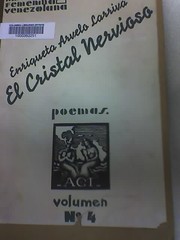
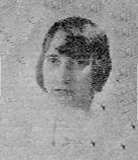
Poetry Month: Day 2, Enriqueta Arvelo Larriva

enriqueta arvelo larriva

Happy Poetry Month! Today I have been thinking about Enriqueta Arvelo Larriva, a Venezuelan poet from the 20th century (1886-1962). Her poems are small and odd, but huge internally, like a pocket universe captured and studied from all sides; a bit abstract and philosophical. This, at a time when it seems to me like the way to be a famous woman poet was to blaze passionately forth in a sort of meteoric scandal of words. Arvelo Larriva's positioning of herself is at the same time very personal and connected to the specific landscape of the Venezuelan llanos, the central plains -- a tropical prairie. But at the same time she positioned herself as a very abstract, analytical, point of human consciousness.

Arvelo Larriva began writing and publishing around 1920 that I can verify (but I have also read she was a poet beginning at age 17, much earlier). Most of her poems that I've translated were published in the 1920s, but I don't have all the research done to know exactly when they were written.

I'd like to point out a pattern I have found in looking at the work of women poets in Latin America. Their poetry was often being published little by little in journals, the same journals as more famous men who were their peers, who were in their same literary circles. But the men became famous more quickly, had books published earlier. I think this is one reason that books of literary history tend to describe the women as footnotes, afterthoughts, imitators, or as not quite catching the wave of a literary movement. It appears from short biographical notes on Arvelo Larriva that she began publishing in 1939. This is not true -- she was publishing as early as 1918, and certainly throughout the 1920s, and was part of the Generación de 1918; and was part of the Vanguard of the 1920s student movement as well.

Why do I care? Well, because histories talk about those movements - but leave her out, or only mention her 20 years after her vital, early work. The elision of 20 or more years of her publishing history means that she is also cut off from politics; her brother and others of her political circle were jailed in the 1920s. She remained in their hometown on the prairies. My feeling is that the story of her life might be quite interesting and complicated, but that complication is not represented in any descriptions I've seen -- which just marvel at how she could write clever poems even though she lives out in the sticks instead of in the exciting capital.

Her work persistently reminds me of the somewhat better-known poems by David Rosenmann-Taub from the 1950s. I'll talk about his poems later this month and connect back to this post on Arvelo Larriva. I also think of some of the short airy poems of García Lorca.

So, onward to a few poems. They might not be your cup of tea. But I get very excited over their depth and over how different they are from other poems of the time. They stand out to me. Also, since I have read a bunch of her work, I am able to see some things in a larger context. So if it seems that I am reading too much into a tiny poem, try to bear with me.

Destino


Un oscuro impulso incendió mis bosques
¿Quién me dejó sobre las cenizas?

Andaba el viento sin encuentros.
Emergían ecos mudos no sembrados.

Partieron el cielo pájaros sin nidos.
El último polvo nubló la frontera.

Inquieta y sumisa, me quedé en mi voz.

Destiny


A dark impulse burned up my forests.
Who is left for me from the ashes?

The wind roamed alone, meeting no one.
Echoes emerged, mute, unsown.

Birds without nests divided the skies.
The last dust clouded the frontier.

Anxious and meek, I dwell in my voice.

"Destino" can be read in light of the Venezuelan llanos and the prairie burn-off of the dry season. Yet, like many of her poems, it can be read as a political commentary. There is the “dry season” layer, specific to the geography of Barinas, where she lives; the tangled, thorny groves are burned with controlled fires in order to clear room for new growth for vast herds of cattle. The poem could also work as a personal one about philosophical and spiritual renewal. However, the “pájaros sin nidos” ‘birds without nests’ can also be read as the journalists, students, and poets who had to flee the country under the rule of Juan Vicente Gómez, after the 1927 student uprisings or other political clashes.

Enriqueta Arvelo Larriva

The creative act of the word, of poetry, is presented as a solution to the problems posed in “Destino” as in many of her other poems. I see her as writing with intense vitality about violence, revolution, politics. But as encoding those concepts within a sort of personal artistic framework, where the poet's voice breaks out of everyday life, a jailbreak from reason and order.

To be honest here on my translation, I am not happy with those birds without nests. Well, how long can one stare at the page muttering, "homeless birds... birds without nests... nestless..... no, dammit" before one just goes with whatEVER. Sometimes, I will be driving down the highway and a line of a poem I translated years ago will pop into my head -- one of this sort of line, where my English is clumsy and graceless -- and the perfect, beautiful phrase will come to me in a flash. From what people say, this happens to all translators and that is why we are always revising. I can work very hard on a translation, and feel in the groove for 90% of it, but that other 10% that just wasn't inspired, is a torment.

I am also fond of this poem:


Vive una guerra


Vive una guerra no advenida. Guerra
con santo y seña, con la orden del día,
con partes, con palomas mensajeras.

Guerra pujante dentro de las vidas.
No digo en las arterias; más adentro.

Ni un estampido ni un rojor de fuego
ni humo vago dan desnudo indicio.

Mas paz de tiza la refleja entera.


And I will give you the first bit, which I think is interesting to translate. Try it yourself as a challenge, if you like.
A war lives


A war lives, unheralded. War
with saint and sign, with the order of day,
with parts of things, with messenger doves.

War throbbing inside whole lives.
I don't say in the veins; deeper inside.


“Vive una guerra” continues the internalization of violent metaphors, with war metaphors to represent existential and philosophical struggles.

Someday I would like to really do her poetry justice, and translate her first two books. Just the little bit that I do know about her family (which included many poets) and her life and about Venezuelan politics, history, and geography, illuminates the poems for me. If I could do the original research, find the journals where her work first appeared, read her poems in that context, I imagine that I could translate them better, explain them, present them in a context that would help other people see where the poems lead.

There is more to say about the ways that Arvelo Larriva was framed as a woman, and about the gendering of literary history as it happens and in hindsight. I guess I'll go into that more in future posts as I talk about other poets and their lives.

Enriqueta Arvelo Larriva

What I truly wish for is the ability to get some good, lowdown, dirty gossip. I'd like to know the poets I translate, who have been dead since before I was born, in the same way that I know the poets who are alive now in my city; what do people think of them, really? What are they like? Would I have liked hanging around with Enriqueta? Was she rude, kind, radical, bitchy, boring, pedantic, vindictive, wise? Was she more interesting when she was young? What was the course of her life? With many poets, I do get a sense for the arc of their lives and careers. With Enriqueta, I barely know a thing. And am not likely to get it in this lifetime. Maybe I'll find an old journal or two, or a letter; her letters with Gabriela Mistral and Juana de Ibarbourou. Just knowing those letters exist, changes everything for me.

Maybe someone who knows more will write a longer Wikipedia entry. More likely, some boorish great-nephew will write to me and go "My god! You're talking about old Aunt Netty and her insane scribbling! I didn't think anyone cared about that! Blah blah blah, all those poetry readings, grande dame of Barinitas... She smelled like dusty lavender and dead mice... But, she made good cookies." I can't romanticize my dead poets too much, because I always imagine out those great-nephews who have become excellent dentists and who have healthy lives and perspectives lacking in poetry, who knew only the human being and not the metaphysical point in space and time that was the free-floating philosopher poet.


Technorati Tags:

Digg this

Monday, March 31, 2008

April: National Poetry Month. Post 1: Nestor Perlongher in translation


a
Originally uploaded by Liz Henry
I'm going to try to post every day in April on poetry and poetics. This blog has got some poetry in it, if you dig deep underneath the feminist eyerolling and disability rights and tech stuff.

In the last month, I've been going through my translations and poems from the last 10 years. My work schedule has been light - I am contracting, half-time. And there's a huge backlog of writing which I just never bothered to send anywhere, and didn't blog, figuring I'd send it out later. So, while I send these translations out to journals and publishers, I'll be focusing here on describing work I like, or going through some of my own work.

That sounds boring I'm sure, but let's start with a bang and talk about something super dirty. Let's descend into the mire!

Today I thought about my translations of Nestor Perlongher's poems. Nestor was an Argentinian gay rights activist, sociologist, and poet who died in the mid-90s. He lived in São Paulo for much of the 80s and 90s, and wrote in a mixture of Spanish, Portuguese, and Portuñol, with a little bit of gay street French thrown in. I have read a fair bit about the Argentinian Dirty War. A few years ago, I heard an mp3 of his long poem about the the disappeared, "Cadaveres". It blew my mind. I translated that poem and looked further on the net for his work. Not much was available, but what I found blew me away even more. It was weird, radically messed up, dirty, and queer as hell. It was difficult, disturbing, and beautiful.

Someone said the word "untranslatable" in my hearing. You know what happens next!

Perlongher was a sociologist who studied gay and transsexual street hookers in São Paulo. Wow, did he ever study them.

I am somewhat aware of the activism and politics around global human rights for queer and transgendered people. For example I have read plenty about human trafficking from Brazil to Europe and the U.S. and about the questionable safety of some of the more risky surgeries you can get done in Brazil (and elsewhere in the world). And I am somewhat aware as well of the cultures and communities of trans and queer, transvestite, drag queen, cross dresser, intersex, genderqueer, transsexual, and all that sort of thing in the U.S. There are some interesting differences between how trans people are viewed here vs. how they are viewed in much of Latin America. I set out to learn a bit about that, and did some reading in libraries and on the net as a background to translating Perlongher's poems. It seems to me in many ways that queer urban culture is more global than I knew or expected. Like house music, like the transcendence of Frankie Knuckles, Perlongher's genderqueer hookers would be at home in San Francisco or Chicago, Paris or Bangkok, as much as in São Paulo. And you have only to be even vaguely queer, to listen to Perlongher's voice reading "Cadaveres" in that mp3, to go pretty much instantly, "Okay, that is a gay man talking." If you think about gaydar, going across languages, it is pretty interesting.

Meanwhile, I was reading a bit more about the neobaroque (neobarroco) and neobarroso movements in South America and Cuba.

The poems themselves. What do I mean when I marvel at their spectacular dirtiness? It is hard to describe. They are slippery and pornographic. If you are my mom or something, just stop reading now, because I am going to describe the poetics of cocksucking. There is a pervasive sense of shifting ground, of a moving frame. A phrase will link to the phrase above it and mean one thing, and mean something else on its own when your reading-frame hits it and isolates, and means something else when linked with the phrase that follows; and again in the context of the whole poem, as a flickering impression or kinematoscope, layers up to create a general atmosphere, so that without actually having said the word "cocksucking" or "cum shot", you realize that is what you are reading about. Everything is sort of glistening and sticky. You think of glitter, flouncing, dive bars and back alleys and strip clubs. Celebratory sleaze. It's all blowjobs in the rain with smoky eyeshadow, in some over-romanticized Frenchified movie.

Perlongher's poetics go into the gutter and find amazing beauty - and often, beauty that ties sexuality to resistance to political oppression.

As perhaps you can imagine, the human rights of trans hookers on the streets are not a priority, say, to the police and government. If you are politically active in other areas as well, and you are gay in that context, there is not a lot of recourse for you legally and you are an easy target. But also, as a gay person in a straight world, you have particular survival skills and ways of acting collectively that come in handy during times of particular political repression. I think that is a good angle to keep in mind while reading Perlongher's work. Perlongher was an openly gay activist in Buenos Aires and in Brazil for gay and transgender rights. He also was around in the 80s and early 90s to watch everyone die. He is writes in a way that shows me he is aware of the violence and power imbalances in pornography and in the sex trade.

You see why I have come to love him dearly in the way that translators can love their poets who they have never known.

In the mean time his poetry is also wankery in the other, academic sense of the word, as in Baudrillard wankery, of spectacle and illusion and semiotics, the elusive and illusive web of meaning that surrounds absence & signs.

So, onwards to a snippet of poetry.

My disclaimer here is that I am super aware that in places I might just be dead wrong. And, the nonlinearity of the poem means that even if you understand every word in Spanish, you will be staring at the page wondering what the hell it means. (And, I considered every word's meaning in Portuguese as well, because he did double-triple meanings on purpose, or wanted words to evoke other words.) If you tell me I'm wrong and argue it and back it up, I will listen and be grateful for the help.

Consider this section from "Miché",


la travesti
echada en la ballesta, en los cojines
crispa el puño aureolado de becerros: en ese
vencimiento, o esa doblegación:
de lo crispado:
muelle, acrisolando en miasmas mañaneras la vehemencia del potro:
acrisolando:
la carroña del parque, los buracos de luz, lulú,
luzbel: el crispo: la crispación del pinto:
como esa mano homónima se cierne
sobre el florero que florece, o flora: sobre lo que
florea:
el miché, candoroso, arrebolado
de azahar, de azaleas, monta, como mondando, la
prístina ondulación del agua:
crueldad del firmamento,
del fermento:
atareado en molduras microscópicas, filamentosos mambos:
tensas curvas


the trannygirl
sprawled on the springs, in her cushions
jerks the fist gilded with leather: in that
conquering, or this submission:
of that which jerks
elastic, refiningfined in earlymorning miasmas the vehemence of the colt:
refined:
meatmarket of the park, holes of light, lulu,
lucifer: the jerk: the shuddering of the pinto:
like how that hand homonym purifies itself
on the flowery florist that flowers, or blooms: over that which
flourishes:
the hustler, straightforward, blushing
with orangeblossom, with azalea, like stripping bare, the
pristine undulation of water:
cruelty of the firmament,
of ferment:
busybusy in microscopic moldings, filamentous mambos:
curves tense


Okay, so, just consider that for a bit. I would love to publish the rest but I'll just wait on that for a while. But, if you were going to write a poem about handjobs without ever saying anything directly dirty, here is your model. If you read Spanish you may go and read the rest in the original. It is full of lube, pushing blunt heads, grease, drool, perturbing firmness, throats and petioles, oysters and curves, and shining above the grime and flesh, the sparkle and "authenticity" of gold lamé.

I'd love to talk some time about his poem about Camila O'Gorman. It seems to me to be a perfect encapsulation of a way that gay men see cinematic and tragic femininity. It is all melodrama and heroine and actress, mist and gauze, mixed with sex, death, and of course flesh and dirt. I read it and just can't believe how evocative and weird it is. It makes me think of the scene in Bataille's Blue of Noon where Dirty and the narrator are having sex and fall off a cliff in the muddy rain, or when they are messing with that priest's eyeball. But actually, sort of, the poem is about a 19th century pregnant teenager facing a firing squad. Where the rats and candle wax and worms come into this, I can't say, but they fit just fine.

I love reading Perlongher's poetry. Translating it is like being in poetic free fall. It is outrageously free and wild. It is maddening in its elisions. I could go on and on about it for a very long time, burbling.

Happy Poetry Month!

Digg this

Thursday, September 06, 2007

Wiki Wednesday's talk on Wiktionary and multilingual collaboration

crossposted from my blog at http://socialtext.com

September's Bay Area Wiki Wednesday featured Betsy Megas, a mechanical engineer and Wiktionary administrator, known in the wikiverse as Dvortygirl. She's a Wiki Wednesday regular and spoke at Wikimania 2006. In her talk, she gave us a ton of information on the history of Wiktionary, a tour of its interesting features, and thoughts on possible future directions for this worldwide, massively multilingual collaboration.

Betsy started by explaining the difference between Wikipedia and Wiktionary. Wikipedia's goal is to capture all the knowledge in the world. Except for dictionary definitions! Wiktionary's modest goal is to include all words in all languages. While an encyclopedia article is about a subject, a dictionary definition is about a word.

But what is a dictionary? Betsy went to a library to browse dictionary collections. Some dictionaries focus on types of words: cliches, law, saints, nonsexist language. Others center around types of content: rhymes, usage, etymology, visual information. Others are dictionaries of translation. Wiktionary, because it's not paper, is searchable, unlimited by size; it can evolve; and it has strong ties to people who edit it, and to communities of its editors.

Wiktionary content includes audio pronunciations, definitions, etymologies, metadata such as a word's frequency in English according to all the text on Project Gutenberg; pictures (such as this great photo illustrating the concept of "train wreck"); and videos attached to a word, for example, videos of how to express a word in American Sign Language. It also includes translations.

We went off on a few speculations to future directions for Wiktionary, Wikipedia, and perhaps the entire web. What if links knew why they were linked? For example, why is "Lima" linked to "Peru"? Betsy thinks that we are missing out on a lot of metadata that could be quite useful. And for Wiktionary specifically, what if we had categories that were structured around the functionality of a word, for example, its part of speech?

Betsy then went on to sketch out basic entry layout - which is different in different languages, but which for English is referred to as WT:ELE. She explains the problem of Wiktionary as "We have structured data, and no structure". This is a problem and a feature of many wikis!

Wiktionary has many tools to help with the tension between structure and structurelessness. It heavily relies on entry templates, which fill a regular wikitext entry box with something like this:


==English==

===Noun===
{{en-noun}}

# {{substub}}

===References===
*Add verifiable references here to show where you found the word in use.


Other useful tools depend mostly on automated detection of problems, relying on human beings to do the cleanup by hand. For example, Connel MacKenzie wrote a bot to list potentially messed-up second level article headers, but a person checks each link by hand to do the gardening.

Structurelessness or being structure-light can be a problem for sensible reuse of Wiktionary content. Other dictionary projects such as Onelook and Ninjawords have used content from Wiktionary, but ran into difficulties with their imports. Is Wiktionary content reusable? Yes, but barely.

Somewhere in the mix, we also discussed WT:CFI (Criteria for Inclusion) and WT:RFV (Requests for Verification).

But then, the truly fascinating stuff about translation and multilingual collaboration. Words, or definitions, exist in many places. For example, we might have an English word defined in the English Wiktionary and the Spanish Wiccionario, and then a Spanish equivalent of that word also defined in both places. So, a single word (or definition, or lexeme) can potentially exist in a matrix of all the 2000+ languages which currently have Wiktionaries (or the 6000-7000+ known living languages) squared.

For a taste of how the Wiktionary community has dealt with that level of complexity, take a look at the English entry for the word "board". About halfway down the page, there's a section titled "Translations", with javascript show/hide toggles off to the right hand side of the page. There are many meanings for the English word, including "piece of wood" and "committee". If I show the translations for board meaning a piece of wood, many other languages are listed, with the word in that language as a link. The Dutch word for "piece of wood" is listed as "plank", and if I click that word I get to the English Wiktionary's entry for plank (which, so far, does not list itself as Dutch, but as English and Swedish.) I also noted that the noun form and the verb form of "board" have different sections to show the translations.

Ariel, another Wikipedia and Wiktionary editor and admin, showed us a bit of the guts of the translation template. The page looks like this:

[[{{{2}}}#|{{{2}}}]]

But the code behind it, which you can see if you click to edit the page, looks like this, all on one line (I have added artificial line breaks to protect the width of your browser window)}:

[[{{{2}}}#{{{{#if:{{{xs|}}}|t2|t-sect}}|{{{1|}}}|{{{xs|}}}}}|{{
#if:{{{sc|}}}|{{{{{sc}}}|{{{alt|{{{2}}}}}}}}|{{{alt|{{{2}}}}}}}}]]
 {{#ifeq:{{{1|}}}|{{#language:{{#switch:{{{1|}}}|
nan=zh-min-nan|yue=zh-yue|cmn=zh|{{{1|}}}}}}}||
[[:{{#switch:{{{1}}}|nan=zh-min-nan|yue=zh-yue|
cmn=zh|{{{1}}}}}:{{{2}}}|({{{1}}})]]
}}{{#if:{{{tr|}}}|&
nbsp;({{{tr}}})}}{{#switch:{{{3|}}}|f|m|mf|n|c|nm= {{{{{3}}}}}|
}}{{#switch:{{{4|}}}|s|p= {{{{{4}}}}}|}}

Fortunately, this template has a lovely Talk page which explains everything.

We all sat around marvelling at the extent of language, and the ambition of the multilingual Wiktionary projects. The scope of OmegaWiki was impressive. As Betsy and Ariel demonstrated its editing interface for structured multilingual data, I got a bit scared, though! Maybe a good future step for OmegaWiki contributions could be to build a friendlier editing UI on top of what sounds like a very nice and solid database structure.

We also took a brief tour of Wordreference.com and its forums, which Wordreference editors go through to update the content of its translation dictionaries.

I'm a literary translator, and publish mostly my English translations of Spanish poetry; so I'm a dictionary geek. In order to translate one poem, I might end up in the underbelly of Stanford library, poring over regional dictionaries from 1930s Argentina, as well as browsing online for clues to past and current usage of just a few words in that poem. Wiktionary is a translator's dream — or will be, over time and as more people contribute. I noted as I surfed during Betsy's talk that the Spanish Wiktionary has a core of only 15 or so die-hard contributors. So, with only a little bit of sustained effort, one person could make a substantial difference in a particular language.

The guy who is scanning the OED and who works for the Internet Archive talked about that as an interesting scanning problem. We told him that Kragen has also worked on a similar project. The IA guy, whose name I didn't catch, described his goals of comparing his OCR version to the not-copy-protected first CD version of the second edition.

At some point, someone brought up ideas about structuring and web forms. I have forgotten the exact question, but Betsy's answer was hilariously understated: "I think that the structure of languages is substantially more complex."

Chris Dent brought up some interesting ideas as we closed out the evening. What is a wiki? When we talk about Wikipedia or Wiktionary or most other wiki software implementations, really we're just talking about "the web". And what he thinks wiki originally meant and still means is a particular kind of tight close collaboration. As I understand it, he was saying that possibly we overstate wiki-ness as "editability" when really the whole web is "editable". I thought about this some more. We say we are "editing a page" but really we are creating a copy of the old one, swapping it to the same url, and making our changes. The old page still exists. So for the general web, we can't click on a page to "edit" it, but we can make our own page and reference back to the "old" page, which is essentially the same thing as what most wiki software does; but at a different pace and with different tools and ease of entry/editing. So his point is that wiki-ness is about evolving collaborative narratives. I'm not really sure where to go with that idea, but it was cool to think about and I was inspired by the idea that the entire web, really, has a big button on it that says "Edit This Page".

As is often the case, we had low attendance, but a great speaker and unusually good group discussion. I'm happy with only 10 people being there, if they're the right people. And yet I feel that many people are missing out on this great event. Betsy's going to give me her slides and an audio recording for this month, but next month I will try to get a videocamera and record the entire event. If any actual videobloggers would like to come and do the recording, I'd love it.

Also, tune in next week, or September 16, for the San Francisco Wikipedia/Mediawiki meetup!

Technorati Tags: , , , , ,

Digg this