Showing posts with label disability. Show all posts

Sunday, October 25, 2009

Disability Blog Carnival #59: Disability and Work

The theme for the Disability Blog Carnival #59 is Work and Disability. It's National Disability Employment Awareness Month. Thank you to Penny from the Disability Studies Blog for co-ordinating the Disability Blog Carnival through 60 issues!

Thank you all for your contributions! All through October, they buoyed me up and gave me food for thought. I felt intense pride to be part of this very loosely knit online community of thinkers and writers.

The next Disability Blog Carnival will be hosted by the fantastic group blog FWD/Forward: Feminists With Disabilities.


  • Wheelchair Dancer contributed two posts. In Becoming Disabled On the Job she writes about how even in a supportive workplace there were many obstacles to overcome as her physical capabilities changed over several years.

    Ultimately, I was successful at my job; I wrote my heart out, presented, won awards, grants, and funding; I got myself published. Technically, however, I didn't get my work done on schedule; in fact, it took me approximately two extra years to approximate a body of work like the ones that my peers had on their resumes. I felt like that broken and imposter racehorse, uselessly gimping around behind its pure blood, beautiful, swift sisters.


    Her other post, Disability at Work, focuses on her current job as a dancer, where she is not the only person with a disability! "You know that disability is an important factor in your work environment when . . . " Ha! I love it! I'm printing out her 10 reasons why list and putting it up at my office!

  • Sophia from 'sprokenword has an otherwise excellent post which does contain some hatred expressed towards people riding airport motor transport carts who are fat. If you can read around that or bracket it, read on because the post explores some other important issues. In Disability Employment Awareness Month, Sophia describes her job working for a non-profit open source software company while dealing with gait problems, chronic pain, trouble standing, and difficulty walking. Her situation requires quite a lot of travel. I enjoyed this post and have a lot of respect for the difficulties of travel and Sophia's determination to do it. Sophia's post and Wheelchair Dancer's first post spoke to many of the issues that people with disabilities and chronic pain face in professional careers.

  • Alison Bergblom Johnson, from the blog Writing Mental Illness, posted about poetry as work. Anne Sexton: Patient or Poet. Anne Sexton was a brilliant and hard working poet. She won many awards, including the Pulitzer Prize. But in the psychiatric professions she is a patient and her work is considered as pathology - as evidence of her illness.

  • Deborah Kaplan wants to recognize the ways that her job is awesome in working while disabled: it's really just fine. "I could do most of those infamous "activities of daily living" without help if I had too (since I don't think that Congress defines "open-source coding and checking my feeds" as an activity of daily living). But without adaptive technology, I would not have been able to hold a job for the last 10 years, full stop." Her co-workers and employers are supportive. She has some complicated stuff to say about the tradeoff between working through pain and difficulty vs. taking time off and trying to heal and avoid stress. In all that complexity, though, her day to day experience of work is "pretty damn good".

  • Tlönista's post Work/Ability writees about some of the negative aspects of her experiences working and being a mentally ill person. She wonders how much longer she can go on. "Don’t think about the long term, don’t think about the future, treat your life like a sub-prime loan. For now I am a “good” mentally ill person. Not a menace, not a burden. I am functional. I’m so tired."

  • Sashafeather's post, "Disability and Work: What I do" centers on Ursula K. Le Guin's science fiction book about an anarchist planet, The Dispossessed, where the word for work is the same as the word for play. Sashafeather describes work/play as "what occupies a person's time, and what one does with the people in one's community". She does emotional work, self care and pain management, volunteer work for the WisCon feminist science fiction convention, and disability/anti-oppression activism. She moderates several online communities and does creative work in media fandom.

    Her post made me think about self-care and pain management as an important part of community work. It's something I have to remind myself of: If I don't deal with my physical pain levels, I will be less useful to the people around me and my community. You might think the motivation of "not being in so much pain" would be enough. Often it's not.

    And she moves into very interesting territory in writing about work, disability, and feminism:
    I have personally benefitted from the feminist idea of work being a socially constructed idea, and "women's work" such as housework, childcare, and care of the elderly and ill being often unpaid or underpaid and devalued by society. The reason women are paid less than men is because women's work is undervalued. Women often provide emotional support for others, they build friendships, they build communities, they build homes. All of this takes time and effort.

    The categories of women and disabled people intersect hugely. The work of disabled people is also devalued, and disabled people face huge barriers such as pain, exhaustion, mobility and cognitive impairments, communication differences, discrimination in the work place and the wider world, and a lack of basic access to buildings, services, and transportation.


  • Eva from The Deal with Disability wrote and posted a video of herself at her dogwalking job. Sometimes accessibility is more than meets the eye. She posts flyers for her business at veterinarians' offices and was showing how though she found out she couldn't get into the office there, the staff's attitude was polite and helpful. Eva goes on to point out factors other than steps or ramps that affect accessibility.

  • The spaces in my résumé by codeman38 talks about some of the practical difficulties in getting a job by traditional means. Interviews, transport, and phone calls are not completely impossible for him as an autistic person but they are definitely obstacles. He finds jobs through friends and family.

  • Tera from Sweet Perdition writes about her job at a local game store: I am Lord Voldemort. She works for store credit at a job that her college professors would consider below her capacity - but she loves her work and their appreciation of her.
    Sometimes you think about getting a proper job, one that pays you money or, at the very least, requires you to leave the house, but you don’t want one. You realize that you don’t really want a lot of things that you’ve grown up hearing independent adults must have . . . But all this guilt is just society’s poison coursing through your brain; it isn’t you. The things you want–really want, not just think you should want in order to be a real person–are not the things your culture wants for you. Popular culture doesn’t have many models for the kind of person you are.


  • Cheryl from Uppity Crip has two posts to contribute. Heads up that her blog has music on auto-play. 51% of Workplace Accomodations Cost Nothing and Mental Illness is Still a Big Stigma.

  • I posted on BlogHer.com on Working Women With Disabilities. I was feeling exhausted and disheartened, and wanted to see other people's thoughts on working and being disabled. My own thoughts on the subject are going to take me a while to put together. When I post about my personal experiences with losing jobs, struggling to get SSI, working part time, passing as able, going back to school, and access issues on the job now that I'm working again. I'll link to it from the comments on this post.

  • Wheelie Catholic posted many times in October with Disability Awareness Month in mind. Her posts are great!

    * The Top Ten Ways For Managers to Screw Up under the ADA
    * Sears case largest disability related employment discrimination settlement
    * National Disability Employment Awareness Month: What Can We Do?
    * PBS to Air Film on Disability Advocates
    * The Campaign for Disability Employment: whatcanyoudocampaign.org
    * Disability Awareness FAIL - this one is hilarious and awful!

    Late additions:

    * Video Post from Bev from Asperger Square 8.


[ETA: warning on fat hatred on a link.]
[ETA again: I phrased that badly and i think misinterpreted sophia's words to be about scooter users. By carts she meant people who are riding the electric carts that airport employees drive around to pick people up. See comments on this post for my thoughts. - Liz 10/28/09]

Thank you all again for clueing me in to your amazing writing. And thanks for reading!

Please stay tuned to FWD/Forward for the next Disability Blog Carnival call for contributions for Carnival #60!

Digg this

Wednesday, October 14, 2009

ADAPT in Atlanta kicking ass, taking names

This weekend I went right from the Blogalicious conference in Atlanta to the end of a march and start of a rally that kicked off a week of activism by ADAPT.

Their goals are, free people from being incarcerated in nursing homes, and kept in there against their will. They back the Money Follows the Person program, which means a person's benefits are under their control rather than under the control of doctors, social workers, and assisted living facilities (who are a powerful medical-industrial complex much like the prison-industrial complex: powerful lobbyists with a lot of money at stake.) Right now ADAPT also supports the Community Choice Act, a bill which you can see and follow directly with OpenCongress.org.


I hopped out of a taxi with two backpacks hanging off the back of my wheelchair, tired enough to cry but feeling jet setty, determined and super excited, as if going to the crip activist prom. As I rolled up an exhausting hill to the Martin Luther King historic site and rose garden. Hundreds and hundreds of disabled people and others were there. There were some songs and short speeches. There seemed to be three or four main organizer dudes, 70s looking older white guys. I gradually realized everyone was in groups based on the color of their tshirts.


I have not been involved on any level other than donating money to ADAPT and though I write about disability online a lot I don't get to hang out with anyone really and I miss that enormously and need some solidarity. So I was so grateful just to be there for a while with everyone. I wanted to stay and support the goals of the organization to get government officials to change policies, get people out of forced institutional living, and embody our political power with direct action.

But I'm also going to frankly tell the story of my afternoon and my thoughts.

First, here is an ADAPT logo and a link to their donation page.

DONATE!!!


Follow NationalADAPT on Twitter
Follow Michigan ADAPT on Twitter


Here's a short speech by Lois who says "Free our brothers and sisters, free our people."


I enjoyed the small bits of chanting we did. How do you spell power? A-D-A-P-T! However I have been in enough rallies in life that I never want to yell "The People united will never be defeated" again. Did it anyway in the heat of the moment. But I draw the line at "Hey Hey Ho Ho." A person has to have some boundaries. Hah!

Andrew Jones speaks about getting out of an institution with the MFP program which has now been denied funding. I missed videoing the second bit of his talk, which was fantastic (my camera ran out of batteries just then.)


Later that afternoon I went to shake Andrew's hand and tell him I'd upload the video of part of his speech, and he raffishly explained to me that I was a rather attractive and curvaceous young lady. Thanks, Andrew, but LOL that was some quick work, how about making friends first, also, actually I am 40 and prideful of my mature charms and middle aged wisdom. You are certainly silver tongued though and should get on email. It would work for you.

Thank you ASL interpreters. Y'all worked so hard. And thanks ADAPT for structuring that constant side by side translation.

ADAPT rally and march in Atlanta, Sunday

So then, there was a sort of extra staged bit which I had mixed feelings about, keep in mind I am a total outsider to ADAPT so take it all with a grain of salt. Delores Bates and Kathy and Bodie came up to the front of the rally and did not speak but the main organizer guy told Delores' story of being in an institution for "seizures" for the last 43 years. She just got out, I guess with ADAPT's help, this September, to live in her own place. IT was her 57th birthday on the day of the rally and they presented her with a birthday cake and a giant card with lots of signatures. We all sang her Happy Birthday. It was her first birthday on the outside in 43 years.


So, okay, I cried like a baby, but I also was like "So, fucking give her a piece of her own cake then? Also, what she have to say about it if anything?" And felt it was a bit stagey and poster-childy. I talked with Delores a bit afterwards and asked her if I could take a picture, she smiled and nodded and I showed her the photos in my camera for a bit. I wished she could talk with me. Thank you Delores for contributing your story and your birthday moment to ADAPT and all of us in the crowd. Congratulations on getting out.

ADAPT rally and march in Atlanta, Sunday

I wondered what happened next and I imagined again her having email and showing her Eva's The Deal with Disability blog entries so she could totally crack up laughing. And that she could have a Facebook page and people could donate directly to her if they wanted and if they cried while singing her Happy Birthday rather than it being sort of showcase for ADAPT, though I also felt like ADAPT probably does right by her and she might be happy to donate that publicity about her life for the good of others. Basically I had my little social media empowerment fantasies and started making real life plots to go to nursing homes in my area and implement my idea to get them online with wireless and take it from there. More about this later on Hack Ability.

Here are some scenes of the people and the crowd.

ADAPT rally and march in Atlanta, Sunday

ADAPT rally and march in Atlanta, Sunday

ADAPT rally and march in Atlanta, Sunday

ADAPT rally and march in Atlanta, Sunday

ADAPT rally and march in Atlanta, Sunday

ADAPT rally and march in Atlanta, Sunday

I saw my friend Bethany and was very excited! We were on a panel together at the Sex:Tech conference. Then wandering around for a while I introduced myself to some women named Naomi and Joanne. They were very persuasive trying to get me to stay. I thought about calling work and begging for time off without pay, and trying to find child care, and seeing if I could change my plane ticket instead of leaving that night. Would it be possible? I considered just "accidentally" missing my plane and finding a place to stay overnight. But I'd have to accomplish all that in something like 2 hours and I didn't want to let my employers down or my family. If only I had planned to stay.


ADAPT rally and march in Atlanta, Sunday

Then people took off up the big ramp out of the park and up another hill to Park Manor nursing home, right next to the Rose Garden. I asked a guy to hold my hand and pull me up the hill. (Thanks!) We all marched and rolled past and waved. The Older People for Community Choice stayed outside the windows with a big banner, waving, till the end of the parade.

ADAPT rally and march in Atlanta, Sunday

Now here is the "Stay on the Sidewalk" bit, where I rant at length!

As I rolled down hill at the tail end of the march I made friends with a guy named Tali and soon we were deep in discussion about disability rights politics. Over the next few blocks we kept getting yelled at to get into single file. The march went on and on and Tali started to give me a lift - I hung onto the side of his power chair so he could pull me (and my giant backpack) up the hills (which no one who isn't in a manual chair would even think of as "hills"). We were all in the middle of the right lane of the road. Basically I don't react well to senseless orders and I'm proud of my capability to land in a strange city and get around. Also, i know how to cross the street but at every intersection another person usually one on 2 legs was screaming at me through a megaphone to keep up. This one older lady behind us in a power chair was very, very upset that Tali and I were not following the rules. I was half a lane away from the part of the street that was open to traffic and at no time was in any danger. What I think happened was a vicious cycle of this lady's instant judgement of me as a spoiled bratty child of privilege who needed to be controlled. And this kicked in all her officiousness, which in turn pushed my buttons big time so I refused to do what she said. As disabled people (or people in general) we are not served well by doing what we're told without using our own judgement. By the end of the march I was not only so mad I could spit, I was ready to go get hit by a car just out of spite. If not rolling up huge, horrible hills, being yelled at every inch while I was deep in talk with Tali, I would have liked to have a good heart to heart talk with that lady about authority, privilege, hierarchies, rules, race, disability, internalized oppression, and so on, and I mean that sincerely. Instead I lost my temper and just kept yelling No, leave me alone. The worst moment was when she decided I was too far back at the end of the line of the parade and she started yelling for someone to come and push me. "We've got a manual wheelchair here who needs a pusher" And that sent me over the edge of rage to be referred to like that. I also fight very hard to be independent in big and small ways. So it pisses me off that someone else thinks they get to decide when I need "help" which in this case would not have been help. Tali and I were cussing everyone out loudly and yelling No sorry don't need help we're anarchists. I also had some commentary from walking organizers in orange shirts about "how well I was doing"... thanks but shut up, that was a patronizing and unnecessary thing to say.

The thing is, i've been an activist and organizer for years and I know how to organize a march or parade, I know you have to get permits for it and work with the city and the police, I know how to block traffic as safely as possible, and I've been to many rallies where there are guys barking orders through megaphones at people who don't need to be ordered around at that moment, because they panic a little at being responsible and in a position of authority, and so they have to go around displaying it, because they're worried and need the feedback and reassurance that their authority is *working*. I would like to tell those guys to take a chill pill. Unless it is an actual crisis situation, you are not helping, you are just training people not to think for themselves, and causing a reaction of confusion and resentment. And in an actual crisis situation, it may very well NOT BE YOU with the megaphone and orange vest who keeps a cool head and exhibits leadership. To be overly generous, there is the opposite kind of asshole in rallies with a black bandana who is just there to fuck shit up and set a newspaper vending machine on fire and they can also kiss my ass. And I'm not that kind of asshole, i'm the *journalist kind of asshole* and also one of those rogue computer people. In any situation I look to whoever is sane and making sense and being effective. If the most sensible person there is me, then I lead. In a situation where I have information that shows that it is best for another person to lead and coordinate and there are rules that make sense, then it is best for me to go with that. That, for people fighting for "empowerment" should not be hard to understand.

Here's how I felt about it at the time and Tali too....

ADAPT rally and march in Atlanta, Sunday

LOL!!!

Tali especially since he was put into a different "color group" as Bethany who he had specifically come there to meet as his one friend at the march and then a bunch of organizers wouldn't "let" him sit with her since he had the wrong color tshirt on or something. Um. !!?? What possible purpose could this serve. We were told over and over again that people were trying to PROTECT US. What's wrong with that statement should be a bit obvious.

Now if it is directly going to contribute to saving someone's live or helping us not be harmed in some way I can shut up about my personal dislike of orders and my special snowflake self and rights, and be dutiful for common good, but this was NOT THAT MOMENT.

Near the end of the march back I ran into my blog friend PhilosopherCrip,

ADAPT rally and march in Atlanta, Sunday

I adore him!

We spoke super briefly and he sized up my state of mind and I think, in a post later, actually partly answered it by explaining ADAPT's organizational philosophy and how it goes into military organization mode during Actions.

Now, when folks refer to ADAPT as the “militant” wing of the disability rights movement, they are more accurate than they may realize.  To some degree, ADAPT’s organizational structure is a representative democracy as actions are being deliberated and planned.  However, when the wheelchair tire rubber meets the road, we turn into a highly authoritarian, quasi-militaristic structure, complete with chain of command and an expectation to follow orders exactly.  This has all been a matter of reflection for me (particularly how trust relationships operate within a direct action activism structure), some of which will hopefully find its way into a future blog entry. 

I appreciate that explanation very much and it goes a fairly long way to quench my irritation. However I have a meta irritation which is that a lot of the people at the rally might not have the luxury of being irritated or going off like I could to do their own thing. There was not good information passed out to people. A lot of people don't have independent means as far as money. The pace of activities was brutally fast. I was increaasingly conscious of my own extreme privilege relative to others there. I could at any point just call a taxi and go wherever I damn pleased. So I could criticize the leadership all I wanted. That is not a good feeling, it's not right or fair, and to me is a sign something is not right in a power structure. I was like, damn, I'm even more happy for my job because it means i'm not subject to being grateful to these officious do gooders to boss me around while they're "helping me" "for my own protection".

When I'm getting arrested or facing some pepper spray then I appreciate organization but being "protected" from the simple act of wheeling down the street next to my friend ... no thanks.

As an amateur leader myself in some situations I would advise other "organizers" to cope with loose cannons like me by valuing their capabilities and not trying too hard to rule over them in the small stuff. It backfires. Just let them do their thing and then when the time is ripe, co-opt them. (LOL AGAIN) (I say this mostly to make Joe/PhilosopherCrip crack up laughing)

And as I bitched about this to my friends a lot of them said "Yeah, that's why I don't really hang with ADAPT, that stuff turns me off."

That is too bad and it's feedback that should not be dismissed.

On another level of meta I would question whether the organization has a fair amount of military veterans in it who perpetuate their drill sergeant style and somewhat out of date organizational tactics. We should be empowering each other with information and two way access to public discourse in ALL WAYS so that we can act collectively in a swarm-like fashion. What y'all need is flash mobs, not paramilitary squads and cells.

ADAPT rally and march in Atlanta, Sunday

I really do respect all that ADAPT has achieved and does!!!!

But check what you're doing and listen up. Many aspects of the rally and march reminded me of my dealings in the Houston Astrodome during Katrina with the Red Cross officials vs. the rogue anarchist computer people. And I want to tell you that what on some level what got people the hell out of that refugee camp was information and connectivity: phones and email, myspace and facebook and search engines and the web. Not Professional Organizers and charity and hierarchical leadership that hugs information and power tight to its chest. A flow of information means that people can make decisions and act together. You all need some wing of your organization that works to those ends too.

Anyway, at the hotel, I actually used my privilege to take our asses to the hotel bar and have a much needed beer and sandwich in the 20 minutes before I had to catch a taxi and plane out of town. The bar waitress was SO nice and saw I was looking for a power outlet to plug in my laptop, and she brought me my sandwich to go so I could eat some of it and take the rest. She was completely unfazed by our wheelchairs. Omni Hotel, you rock. Bethany and Sara and Tali it was the highlight of my trip to get to hang out with you.

ADAPT rally and march in Atlanta, Sunday

So I flew off literally sobbing with my desire to stay there and be in the week's actions despite my rant about power structures and being yelled at, so ready to go for it.

I resolved to donate my week's salary and to exhort other people all week to donate to the cause either by directly helping someone out or donating to ADAPT to support their actions and organization.

Would anyone out there like to match my donation? Email me, lizhenry@gmail.com, or comment here.

The next day I woke up at 5am and began following what was happening in Atlanta. All day throughout work I could not stop thinking of all of y'all in Atlanta, cheering you on over Twitter, I worked to post and tag all my photos and videos as fast as possible as the only contribution I could make remotely.

What you all achieved and are doing today is so beautiful. Congratulations on getting into the Governor's office, HUD and HHS and making top officials agree to meet right then and there and begin negotiations. So smart and so effective. You got a response and got the politicians to listen and take our power seriously. YEAH. (And direct action and the threat of an endless sit in or hundreds of us dragged out in handcuffs, ie, PR disaster, IS WHAT IT TAKES. RIGHT ON.) Good job with the talk of timelines and scheduling a series of committee meetings. Please, report on this in as much detail as you can on the net. And to report on it ASAP so we know what's going down. A lot of us are watching and putting our trust in you right now to represent our interests.

Thanks for listening. Also, thanks to Nick Dupree for letting me know about the rally and actions in the first place (last week on his blog). Now, anyone who read this who can afford it go and donate. Consider trying to get your employers or family or friends to donate as well. And, go read up on the other posts in Nick Dupree's ADAPT Blogswarm !

Digg this

Friday, October 09, 2009

A decent airline experience for once

Flying while disabled often tries my patience. Today's experience on Delta was actually decent. I'm so surprised. Though I missed my flight the ticket agents got me on another one a few hours later. The guy in the pink tie was especially nice. At the gate, no one hassled me, but one of the agents came out, crouched down next to my wheelchair at my level, and discreetly talked to me in a way that was just like two human beings talking. That's rare. She asked about an aisle chair, if I needed anything, if I wanted to board first, and gave me a gate tag, without lecturing me what was going to happen and what I did wrong or acting freaked out or being condescending or hostile. Nobody talked about me in front of me like I wasn't there. No one grabbed or pushed me. Yay!

I noticed the people working for the airline were mostly dressed in jeans and tshirts and sweaters, which I also kind of appreciated and which maybe contributed to their acting decent.

I got on the plane, one of the agents carried my bag on, and no one fussed or acted like I had two heads. (If you actually do have two heads, I apologize for my mono-headular-centric language...)

They also put me 2 rows from the plane entrance and bathroom. There is wifi on the plane (though it's only free the first flight.)

Really not bad. I think it speaks more to the horrible experiences I've had with other airlines (see I am not the wheelchair or Why is airline travel so brutal for disabled people? ) but since I've blogged so negatively about airline travel, I'd like to show that it's not all about the fiery complaining over here, and give Delta some props. Get it... "props"?

Thanks for not sucking. Meanwhile, I got some work done with the free wi-fi, and I'm excited about being in Atlanta for Blogalicious Weekend, for women bloggers celebrating their diversity and so on (representing BlogHer, where I work as a web producer and developer). I'm also really excited that I'm going to get to participate in some of ADAPT's actions on Sunday and for that I'll be participating in Nick Dupree's ADAPT Blogswarm and will, I hope, interview some folks about the Community Choice Act to end institutionalization for people with disabilities.

Digg this

Tuesday, October 06, 2009

Disability Blog Carnival #59: Disability and Work

I read the other day on Disability Studies blog that they were thinking of ending the Disability Blog Carnival. I'd like to see it keep going! So I offered to host this month's edition, on Work, in honor of October being Disability Employment Awareness Month in the United States. And, as I went looking for what people with disabilities had to say about work, to write a long post on Working Women With Disabilities, I wished for more blogging on the subject.

Here's the announcement - please repost and email to pass it on!


For this blog carnival, please write about anything you please on or tangential to Disability and Work.

Here are some suggested starting points: What work do you do? How's that going? Do you get paid for it, or is it volunteer work or something you do because you just love it? What blocks you from employment? If you're employed, what could be better? Do you want a paying job, or do you feel you contribute to society just fine without one? What unpaid work do you do that you value or that others value, for example, emotional support in relationships? If you're a family member, friend or ally of a person with a disability, what thoughts do you have on work and employment? What's the employment situation like for PWD in your country or region ?

Email your post URL, title, and the name you go by, to me, Liz, at
lizhenry@gmail.com.

I'll post the final Carnival on Composite: Tech & Poetics and
Hack Ability: DIY for PWD on October 25.


Thank you! I look forward to reading some fantastic posts!

Digg this

Monday, August 10, 2009

A dose of morning rage

This morning on my way to work at the busy intersection near my house, I passed some firefighters holding out boots to collect spare change for "Jerry's Kids". How much do I hate this? Do these people have the faintest clue how hideous their actions are, how dehumanizing, how much they set back human rights and disability activism?

My blood boils and I wanted to stop the car, get out and scream at them. Their good intentions are no excuse for their ignorance.

Sorry but I have no patience to suffer these fools or Christopher Reeve's whole thing.

Anyone in need of some education on thse points can go read

* Jerry Lewis, Oscar-sanctioned "Humanitarian". The brilliant journalist and blogger Laura Hershey tells it!

* Jesus Christ, We're Screwed - Bad Cripple's take on Josie Byzek's take on Obama's speech to disability activists

* Ragged Edge's explanation of some of the background of activism against the Jerry Lewis Telethon and its mentality

* Jerry Lewis vs Jerry's Kids - infamous "living waterbed" statement

* Bigotry towards people with disabilities

If it’s pity we’ll get some money. I’m just giving you the facts. Pity … if you don’t want to be pitied for being a cripple in a wheelchair, don’t come out of the house.


I could go on, and on...

If you want to support people with disabilities how about keep your spare change or your Telethon donations in your pocket. Instead go support what people with disabilities actually say they want and need to have an independent life.

Like the Community Choice Act!

Which I wish the Obama administration would talk about a bit more. I agree with Bad Cripple here:
What did I get out of Obama's speech?Obama wants to cure crippled people, hence he talks about Reeve and better medical care. At no point is any mention made that most people with a disability are uninsured and cannot afford health care. When obstacles are encountered in the post ADA land of nirvana the super cripple will overcome and persevere. How does he know this? Obama's father-in-law woke up early and made sure he had time to button his shirt and still get to work on time. He even struggled to walk up the steps of his home with two canes. Some how I think this was the least of his problems. Obama's words were not inspiring stuff but damaging stereotype. As Obama spoke I wondered what happened to his support for the Community Choice Act? This surely would have helped his father-in-law. No mention of this legislation was made, legislation he now supports in theory but it is off the table when talking about health care reform. Obama did not say a word, not one, about the current rate of unemployment among people with a disability. When the ADA was passed 19 years ago the unemployment rate was 70%, today it is 66% Surely we can do better in almost two decades.


If you need any more "educating" go read Nick Dupree's blog and also bookmark Blogging Against Disablism Day from this year or past years and read them every once in a while, I promise your perspective will change.

And, a personal Fuck You from me to Jerry Lewis.

Digg this

Wednesday, June 10, 2009

Kiva lending and people with disabilities

Kiva has opened up to lending to entrepeneurs within the U.S. and I think this is something disability activists and independent living centers need to jump on immediately. This won't help everyone, but it could help quite a few people with disabilities to start their own businesses.

For example, look at these Pass Plan examples.

# PASS Plan Abstract: Joseph's goal is to become a full-time office clerk for the state. He has the disability label of Muscular Distrophy, Cognitive, and Vision Impairments, and uses a wheel chair. Joseph's PASS will pay for OJT training experiences, a van, insurance, registration, gas maintenance, and a driver. This PASS will be used to purchase of a van, install lift modifications, and hire a personal attendant. The yearly cost is $1884.00. This PASS is for six years and a total amount of $11,304. This PASS comes from the Chicago Regional SSA Office.

How different would that proposal look if it were a request for capital and a Kiva-style loan (OR... a donation.) I've been saying for a while that what is insurmountable to a PWD, like simply needing a ramp built and a decent wheelchair, say a $5000 cost, would be easily obtainable through profiles and requests for donations or loans. Make the problem and the solution visible, and people will help, because to someone that $5000 is like pocket change and to a much greater pool of people on the Internet, a lot of small donations could make it up in no time. This would eliminate some of the structure of "professionals" who, frankly, siphon off 2/3 of the resources allocated to empower people with disabilities. Think of the people who have comfortable lives as professional experts who administer charity but who keep the objects of their charity in crazy poverty. It's not their fault, it's a systemic fault, but there's something deeply wrong there.

How might a Kiva-like structure combine with Ticket to Work to make it easier for people with disabilities not just to find jobs but to go into business for themselves. Look at the collectives and cooperatives on Kiva and how a group of women will band together. That's the kind of organization we might need to develop. If you get benefits and depend on them for, say, your health care, your personal care attendent, your ventilator; then you can't have any resources and are trapped in an endless poverty, you can't accumulate resources, you are kept in dependency. I have some problems with "being middle class" as a goal and yet faced with things like institutional living and the loss of control of our lives I think it's not a bad goal to work towards.

Digg this

Tuesday, March 31, 2009

Photoessay of the 805 Veterans disabled parking problem

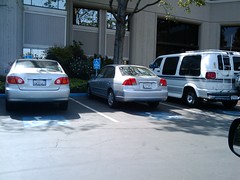
Here is a visual explanation of part of the problem with disabled parking at this building.

1:48 pm Tuesday March 31st. I drove into the front parking lot. I could see the front 2 spots were full. I drove to the back. (I didn't take a photo.)

1:50 pm Tuesday March 31st. All three spots in the back are full.

All 3 spots in back full, 1:50pm Tuesday

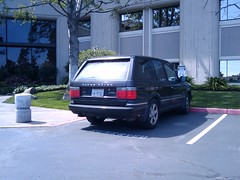
As I paused to take this photo, a grey haired man in a suit and a dark SUV pulled into the reserved red zone, the spot next to the curb cut, where I was intending to park. I drove around to the front lot again to check the spaces there and to avoid having to interact with the man who was surely someone who works with the property manager.

A reserved spot

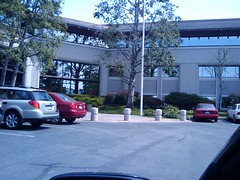
A couple of minutes later in the front lot, the two spaces there were still full. They are both inadequately marked as disabled spots. Frequently, people without placards park in the badly marked spot on the right-hand side.

the front 2 spots full, 1:50pm Tuesday

As I paused to take the picture above, the man in the suit who had been driving the SUV came out of the front doors and yelled something at me. I drove away, because I did not want to have any kind of confrontation with him.

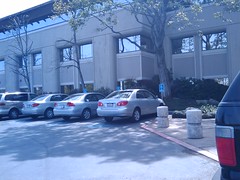
1:55pm Tuesday. I drove to the back of the building again. The three spots were full, this time with the van gone and a different car in the space closest to the curb.

The back three spots are full, with a different car in the van spot. 1:55pm Tuesday

In retrospect, I think the man in the suit might have been yelling at me that there was a disabled spot open. I am led to think that he noticed me in the back lot, and knew specifically who I was.

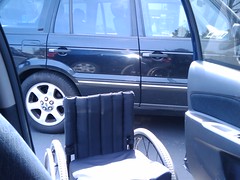
It is a sign of the high demand for disabled parking spots at this building that by the time I drove to the back from the front, an open blue-placard spot had filled up. As I parked in the red zone in a "reserved" spot next to the man in the suit's SUV, I noted another person with a blue placard driving past me and the full spots that were marked for disabled parking. I did not get their photo however. My camera was in my pocket and I was pulling my wheelchair parts out of the front passenger seat over the steering wheel and assembling the chair on the ground next to my car.

I parked in a red "reserved" spot.

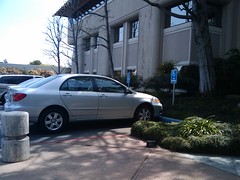
As I came into work from the parking lot I snapped this photo to illustrate that the "van accessible" spot is not properly marked or configured. The landscaping and the concrete bollard both potentially interfere with a van lift or ramp. The space is not wide enough and not properly striped.

The "van accessible" spot, which isn't.

The elevator doors in the building opened for me and I backed up to let out an elderly lady in a chair and her companion who was pushing her chair. We smiled at each other and I wished we could stop and have a good conversation. I admired the brilliant whiteness of her hair and she looked at my sparkly wheels; I wondered what she thought of them. Frankly, I enjoy getting to see the high number of other wheelchair users who come to this building to go to the PAMF clinic. We always have a friendly smile of acknowledgement or a nice word for each other.

That entire sequence (minus the guy in the van) happens nearly every day at this building no matter what time I arrive at work. By the time I leave late in the day, most of the spots are empty.

I hope that explains things a little bit better for the "able-bodied". The good thing about this experience today is that it wasn't raining.

Digg this

Monday, March 30, 2009

ADA struggle at my workplace

It has been at a year now since I first started asking the office building where I work to add disabled parking spots. They continue to refuse, and as I continue reporting them to the city, they continue coming to my managers at work to complain about me. I consider that to be very wrong. It is retaliatory action for my asking for accomodations and reporting them to Code Enforcement when they did not respond.

I spoke several times over email and in person with the building manager last year. I spoke with city code enforcement. I continue having to speak about it with people at my workplace, because of the repeated harassment from the building manager. Last year I also contacted a clinic manager at Palo Alto Medical Foundation, another tenant of the building, who I believe should be actively involved in protecting its patients and who I would still like to invite to a part of the solution.

I am a blogger. That means that some of the time, I'm a citizen journalist. When I get stuck, I can always go public. That's what I'm doing. Private conversations on this issue have not gone well for me. People lie and stonewall, and I get put on the spot, I end up being the one under scrutiny. That is wrong. I am not the issue, and I am not the problem. I have been polite and helpful over the course of a year, in pointing out ways the building owners could deal with the issue, I made specific requests, sent links, explained tax breaks available that would help pay for the modifications.

The initial contact with the building managers last May resulted in this:

The building is able to offer much needed medical space to the community without opposition from the city; "currently". We are not a medical building. As you know, the building is required to have a specified number of handicapped parking space in order to meet the standard set forth by the ADA. We have the required number of spaces and no plans currently for adding more.
(from Lauren from Harvard Investment)


Then a lot of messed up things happened. Frank from Harvard Investments came to speak to me in my office. He made many claims about his boss's political friendships with city government, the good that he does for the community in being a landlord of medical office space. He said that if I kept it up, he would make sure nothing happened, he'd drag his feet and "nothing would happen for 10 years and it would just cause trouble for me in the meantime." In a whirl of alternating threats and pleas for sympathy, Frank then made increasing claims of empathy because his grandmother "was in a wheelchair" and he was too during his teenage years. He went into quite an emotional story about his life as a teenager in a wheelchair, wistfully watching the other kids play ball and have fun; the emotional pain he suffered from as a result making him uniquely able to understand "my pain". I did not believe him, and questioned the relevance of his stories and claims. My personal emotions are not the issue. The law, and what it does to help our city's community, and -- for me personally -- my solidarity with other disabled people: those are the issues.

I refused to speak with Frank after that conversation. But I described it in full in an email to my co-worker.

Here is my first letter from last year, after some phone calls that didn't seem to go anywhere. I sent it on May 15, 2008, to the Redwood City Code Enforcement head, Fereydoun Shehabi.


I am a wheelchair user, and I work in an office at 805 Veterans Blvd. in Redwood City. The building has quite a lot of traffic from people with disabilities and elderly, frail people in general, as it hosts large offices from Palo Alto Medical Foundation and other doctors. It has over 280 parking spaces that I counted, but only 3 of those spaces are marked blue as parking for disabled people.

Those spaces fill up quite often. They are not wide enough to allow me to park in the space next to another car and still get my car door open wide enough to pull my wheelchair out of the car, out of the side door, and pop the wheels onto it. The 60 inch between spots with striping, that should be there, is not there.

The building has a central lobby with two large and accessible entrances with automatic doors, one facing the east parking lot and one facing the west lot.

According to the ADA as I understand it, there should be at least 7 spots, evenly distributed around the accessible entrances, and one of those 7 spots should be van-accessible with a 90 inch wide area.

The three existing spots are on the east side of the building, the back entrance bordering on Main Street. Some of the spaces near this entrance are painted red and marked "reserved, private ". The red paint is fairly fresh and appears to be painted over blue paint, though it is somewhat difficult to tell. There is a very nice wide curb cut here.

At the front entrance on the west side of the building that faces Veterans, there is another excellent, wide, curb cut. But, all the spaces nearby are painted red (this time, obviously painted over blue) or gray, also clearly cracked and with blue paint underneath.

I have asked the property manager, Frank Ramirez, twice in writing and once in person to restripe the lot.

He refused to do so and said that the owner is friendly with the Redwood City planning commision. He claimed that it would be too expensive, and that he and the owner would fight any such restriping and delay it for "10 years". I am asking him merely to add some extra spots by the west entrance. I see that the owner is afraid that he will have to tear up landscaping, sprinkler systems, trees, etc. in order to make a wide walkway in front of the spots. I hope that is not necessary and there is some middle ground between that complexity and expense, and doing nothing at all.

At first, Frank Ramirez stated that the building was in total compliance with the ADA. Later, in person, he admitted that he knew it was not, but that they had a special exception in a permit from the city.

I doubt this is true. It looks to me like the building owners had the minimal amount of disabled parking spaces in the past. And at some point, they painted them over for "private use" or as regular spaces.

Frank Ramirez also offered me a "private parking space" if I would stop asking them to comply with the ADA and if I would drop the issue.

I did not feel that is what is best for the community.

Frank also said that the medical clinic is good for the city and community. Yes - but not if someone in a walker gets run over in the parking lot because the owners and the city did not follow the ADA.

Attached is the permit for the building from 2005. The city planner on duty emailed it to me.

Best,

Liz


In the interim, Frank Ramirez in person told me that if I pursued the issue with the city or an ADA complaint, I would force the property owners to terminate their agreement with PAMF, and the City of Redwood City wants to have the PAMF medical clinic here to serve the community, and if I pushed things, I would drive out the clinic. Did I want, Frank asked, to be the person who took away health care for the disabled and elderly people of my community that I was trying to help? This argument by Frank hardened my resolve to continue to pursue the issue.

I wrote another round of letters in I think August or September but lost them in a hard drive crash.

A couple of months ago I opened the issue again with the city to ask why they hadn't done anything and got this response:
I recall our last phone conversation regarding your complain. Following
your phone call I had our senior inspector Jerry Schnell to come to the
site and verify the location of disabled parking stalls. He reported to
me that there are several disabled stalls scattered on the site and he
noticed there were two stalls near the main entrance and one in the rear
near exit door. I also called the manager with the phone number that you
provided to me and left a long message requesting for a response but to
no avail.

So the city did not properly inspect or respond to the complaint. Jerry Schnell did not report or take action on the obvious code violations in the parking lot. Nor did he look at the rest of the building; for example, in the lobby the fountain's overhang over the walkway without any indication for a cane is a hazard for people who are visually impaired. Why didn't the city take proper action? Was I being stonewalled, as Frank Ramirez suggested, because the city has a private and friendly agreement with the building owners, basically a golf buddy arrangement? Was Jerry Schnell just unable to do his job correctly? Where is his written assement and report of his inspection? Why didn't Fereydoun Shehabi pursue the property owner's failure to respond to his voicemail?

Why doesn't my city have a clear procedure for its citizens to file such complaints and receive proper consideration and follow up?

I love my city and yet I am now in the position of possibly needing to sue them as well as the building owners, under the ADA.

Why hasn't PAMF management, or any of the doctors who work there, ever noticed and done something about the disgraceful situation that means its own clients and patients can't park safely?

I am not the problem in this equation. No one should bring me into it. No one should call my workplace, my company founders, or my manager. My workplace should not engage in a battle with their landlord or with me over this issue. The issue is not ME. And the issue does not involve them. The issue is, very clearly, that we have a law, the Americans with Disabilities Act. And we have agencies to enforce that law. The building owners are in knowing and active violation of that law. The city failed to enforce the law as they should have.

The building owner needs to fix the problem correctly, and can file for a tax break of up to $15,000 to cover the removal of barriers. There is nothing that says they have to bring everything in the building up to code in a perfect way. But they are required by law to do barrier removal that is readily achievable.

As I look over one of the two documents I have in my hands for this case other than emails, the Feb. 14, 2005 letter from the Planning Commission to Jeffery Teel from PAMF, I can see that the building owners and the city agreed that it is the building owners' responsibility to make many other modifications to the property, such as an accessible and safe path from the city sidewalk to the building entrance. In other words, if you take the bus here, or get here from CalTrain, you can't get to the building entrance without being in the large parking lot and driveways that open onto an extremely busy street. As I know well from trying to go to lunch with my co-workers who simply walk through the parking lot and over the landscaped hill, while I at far below safe eye level for drivers go the long way around through the parking lot. I tried that a couple of times. I saw how unsafe and scary it is. Now I get in my car and drive if I am going to go across the street for lunch. My point is that the building owners know they are supposed to do many things to be in ADA compliance and they have deliberately avoided doing those things to avoid expense despite their contractual agreement to do it.

Here is the report from the City Inspector from Febrary 12, 2009, when one was finally filed in response to my repeated requests for action:

Inadequate disabled access parking stalls.

I haven't seen any response or action from the sending of this letter. But I am very happy to have a copy of it, and grateful that Fereydoun Shehabi sent it to the building manager. I would like to point out that he missed a few problems though.

I am not gearing up for a civil rights battle to demand my personal right to a safe parking spot. I am asking for my community members sake too. And actually I am doing it to demand my right to ask for a reasonable accommodation without the property manager repeatedly harassing me at my workplace by complaining about me to my bosses and throwing the problem back into my lap. More than my rights under the law about parking, I want my rights under the law to protect my employment. That includes protecting me from harassment and retaliatory actions.

I will call PAMF again tomorrow to ask their management and their clinic doctors and patients to join me in an ADA complaint. I will also ask everyone at my workplace to send in the ADA form which I will print out and bring for them. I don't know if I'm going to fill out the form correctly without help from a civil rights lawyer, but I'm going to try. Acting individually, and asking nicely for people to obey a very clear law, and explaining all my reasons for doing so, has not worked. I conclude that only organized political action brought to bear will have any effect in this situation.

If you are in a similar situation, I recommend that you organize political action rather than sending letters every couple of months and trusting that something would happen. Because unfortunately, other people can be greedy and corrupt even where the law in theory protects us.

And if you are a property owner, I recommend that you listen to people who ask for reasonable and readily achievable accommodations, and negotiate in good faith to improve your property.

Digg this

Friday, March 27, 2009

Why is airline travel so brutal for disabled people?

Here's a little bit about my day today and then some thoughts on airports and disability. But my short answer to the question in my title is that U.S. airlines do not even try to comply with the U.S. 1986 ACAA or Air Carrier Access Act, likely because the ACAA is not enforced.

Anyway, my day. I crutched all over the place today for the first time in weeks maybe a couple of months. WHEW. I am tired and exhausted and my leg won't swing forward all the way now. It was a great day though. I worked from bed all morning, dropped Oblomovka off at work and then worked for a few hours from a really nice open air cafe and ran into Jeremy and Bryan.

Then I went to this awesome ping pong club full of gleeful amazing middle school kids having complex after-school chaos with ramen noodle cups, candy bars, wearing gym clothes and pajama pants and flirting and yelling at each other. If I taught or worked with kids again that is my favorite age - when they are still kid-like and especially squirrelly but almost grown up.

On the drive there I was feeling grumpy and gloomy, like, "ugh, the crowded, trafficky, tourist part of town, hilly, I won't be able to park". I worried that I had been stupid, I should have tried to get Oblomovka to go with me, and I thought of back up plans in case I was not able to get into the store (calling their number, asking them to bring the stuff out to me and I could just hand them the money; stopping a random stranger and giving them the money and asking them to get it for me.) The table tennis club turned out to be a tiny and beautiful shop on a flat bit of the street with a semi-legal parking spot right in front, so I crutched into it instead of getting the wheelchair out of the car. The drive back was trafficky and my leg hurt like hell. I played my obnoxious punk rock music and my Gangstagrass CD very loud and enjoyed the weather and the free feeling of driving where I pleased.

I then crutched into the EFF which was probably too much for me and then into a store and another store -- feeling extremely tough. I screamed "Fuck off!" at a car which did not stop rolling towards me as I slowly crossed the street at a crosswalk on crutches with a child hanging off my arm. If the kid had not been with me I might have beat that woman's SUV's headlights in with a crutch just to make a point. Stop your cars, people, don't just keep coming, tapping the brakes to "totally pause" is not enough. It was terrifying.

Home and then we all made party decorations. I have now become one with a beer and a vicodin.

I just got back from a trip and had some more negative airport experiences to add to all the others. Airports are some of the most stressful places for me to be in. They are unusually full of people trying to push me around, take my chair from me, I become an obstacle, a problem, a worry, certainly not a person. A person pushing a stroller poses about the same level of mechanical assistance and possible lack of grace in dealing with the security and airline boarding and yet a stroller-pusher is not pounced on like a soul-sucking inconvenience in their day or a dangerous animal in need of being taken out by a tranquilizer dart, the way that airport and airline people treat me when I'm in a wheelchair.

Tonight I read about Dave Hingsberger's experience with an airport guard telling him that he didn't exist.

He looked at me, annoyed and said, "Luggage can't be left unattended."

"I AM attending it," I said incredulous.

"You don't understand, SOME BODY needs to be in possession of the luggage," he said and I didn't get his implication, not yet, I was still too startled.

"I am in possession of this luggage, it is MINE," my voice is rising.

He looks at me with exaggerated patience, "SOME BODY (long pause) needs to be attending the luggage."

I got it then, I wasn't SOME BODY, "Are you suggesting that I can't supervise my own luggage because I'm in a wheelchair?"

"You need to settle down, sir."

"What are you going to TAZER me? You are stealing my luggage," I'm almost screaming now.
In the comments there is some support and then an influx of trolling and stupid comments. Even some of the "helpful" comments struck me as quite ignorant, for example the one that suggests that the "slightest hint of the ADA" makes people fall all over themselves to get in compliance and be helpful. I have never seen THAT to be true. Maybe in some alternate universe, asking for better access or pointing out someone's insensitivity, rudeness, wrong-headedness regarding access and disability, doesn't result in a bunch of petty officials becoming hostile. People become hostile if I don't kiss their asses for offering me help that I don't need and thus refuse and they certainly get angry and show it if I offer feedback on improving access. Show me some ADA cases that resulted in anything without actual political action. Who seriously thinks that ANYONE... especially anything to do with air transport... lifts a finger to change things because they might get sued? Wake up, folks! The idea of lawsuits does not magically fix all sociopolitical problems and it reeks of privilege and ignorance to go "Oh, well just SUE THEM"... with what energy, time, and resources? With what lawyer who's going to take that case?

While reading the comments thread I realized Laura Hershey has a blog! I only knew about her old web site of archived articles and columns! I am very excited to read back through her blog posts! It's like the most beautiful present! Y'all know how much I love airports, right? Laura wrote a poem about her own feelings about airports. I'm not alone. I also read andabusers' posts on her airport experiences. Did you know that British Airways makes disabled people sit next to the window, in case there's an emergency, so that they won't get in the way of other passengers? NICE. I'm going to be writing an interesting letter to BA. What do you think that will do? Magic lawsuit fairies will sprinkle their pixie dust and BA will re-educate all its employees? At best it will result in a form letter, at worst I earn a flag on some list for being an annoying, difficult airline passenger.

Part of my theory about airports and airlines is that they tend to see travellers like they are all possibly dangerous animals in need of control and a disabled person is likely to be not only personally inconvenient to them as they try to do their job AND because they are not invisible in some hospital or institution and are out in the world, are likely to be uppity cripples who are about to cause some trouble. So they treat us with special rudeness, they single us out as targets of their anger, as people they CAN push around and not suffer any consequences for doing so because the disabled person is ASSUMED by anyone else who comes onto a bad scene to be the obstacle and the difficulty.

I read a great quote tonight from Wheelchair Dancer:
Pain is disabling, but disability is more than than hurt, the impairment, and more even than the attempts to overcome the hurt. Dare I go so far as to say -- *disability* is the wind in your hair, the sun on your back, the fuck you, the acceptance, the culture, the art, the humour, the rebellion, the work, the pleasure, and, yes, the living in pain; this is living unbounded.

Digg this

Thursday, March 26, 2009

Access Sex: panel at SexTech conference

The Access Sex panel on sex education, sexual health, and people with disabilities was just beautiful.

Panelists: Cory Silverberg (http://sexuality.about.com/mbiopage.htm), Bethany Stevens (Morehouse School of Medicine), Liz Henry (BlogHer), Jen Cole (GimpGirl)

Cory Silverberg opened by asking some questions about who was in the audience. Our audience was full of public health workers and health/sex educators and providers.

Then Cory asked what people want from the panel. What do they need to know?
A: How to deal with school, staff, parents. They don't think the kids are at risk. How to get education across? Special ed classes also have to educate to multiple levels at once.

We didn't get a lot of other answers, but I felt like this was a great trick of moderation, a good way to start the panel; it helped me feel connected with the people we were speaking to.

Bethany, Jen, and I each talked for about 10 minutes each. Bethany spoke on models of disability, medical vs. sociopolitical. I spoke about disability and sex. Jen then talked about GimpGirl, a successful, long-lived online community for women with disabilities. We spent the rest of the hour and a half on audience questions and discussions. It was a very lively discussion!

We mentioned the guide for health care providers for disabled women a lot, and here is the link to it: Table Manners and Beyond: The Gynecological Exam for Women with Developmental Disabilities and Other Functional Limitations. Please read it!

Bethany's lightning talk on disability politics

Bethany introduced herself. "My CV is big and throbbing. I released myself from the shackles of Power Point and recommend it to you." Going to talk about different models of disability. Also, with some personal narrative, personal examples of what I mean about different theories. Speaking on an embodied level.

There are two models I want to outline. First, the medical model of disability. I recommend you move away from that. Don't use it in your work. It posits that the problem of disability is on the individual rather than on society. Rather than addressing structural issues of oppression, architectural or social, look at as a social issue with social and political solutions. Medical model puts an onus on individual to normalize their bodies. It puts us in a constricting box of normalcy. The medical model leads us away from civil rights ideology. By pushing the idea of normalcy we create more problems than solutions.

Second, the social model - I want to create a model of the world I want to live in. Michael Oliver in Britain. The idea of impairment is separate from the idea of disability. Separating a functional issue or condition from the social ramifications of that imapirment. For example I have osteogenesis imperfecta or brittle bones. The embodiment of that is being deemed subhuman. That may seem like a dramatic statement, but it is true. We are treated inhumanely. Cory suggests we are the most under-served population for sexual health, education and rights.

Think about the social meanings of disability.

I encourage you in your work to denounce and deconstruct these concepts. It is the first step in creating this revolution of embodiment. By doing this in your work it is liberatory not just for people with disabilities but for all other people. 80% of people in the U.S. will deal with disability in their lives. We have increasing elderly populations. Create that revolution of consciousness starting with young people, teach them that embodiment exists on a spectrum. There is a mental health problem of losing ability.

1) We're often treated as children. I am constantly, people bend down in my face and use baby talk, sing song voice, the disabled people in the crowd here are nodding, it's egregious. I'm a lawyer, shut up and treat me like a human. As I'm aging and becoming more mature, I realize that's maybe not the best response. This issue is a bad one.

2) We are perceived as dependent, always needing help, we're helpless. These things intertwine. Example, when I'm sitting anywhere, recently I was sitting texting someone in front of a building and two people in a row stopped to ask if I needed help. I didn't look helpless or perplexed non-verbally or make any eye contact. But, of course on the other hand, there is something beautiful about that we sometimes need help, we are interdependent. There is beauty in helping each other.

3) Sexuality: it is very pertinent. Pivotal to my life path. Disability and sex focus. The common notion that we are asexual and undesirable. This is a pervasive assumption in all aspects of culture. It is very politically disempowering. We need to be allies with queer people and people of color. This is a tool of oppression, sexuality; stigamatizing our sexuality is a form of dehumanization. It means we are regarded as nonhumans. This legitimizes all sorts of abuse, exclusion, and exploitation. PWD have at least a 2 times higher rate of experiencing sexual abuse than the non-disabled. For example many are abused by caregivers. You might have a choice. Have a care giver? Get a bath plus sexual abuse? Or, not have care, and turn our abuser in? The stereotype of asexuality exists. Sexual silence. It's about anxiety-producing issues; disability and sexuality are both anxiety producing. Exclusion from media representation. Not including PWD in teaching materials. Public health intervention plans don't include us. Think about culture beyond race and ethnicity. Beyond the glbtq axis.

Interweaving some of my narrative. As a young person I was born this way, nowhere was disability mentioned in any classroom space at all. No matter the subject. Maybe in the Holocaust's history but not really. Certainly not in sex ed. The stereotype was that we were asexual and undesirable. I was using dialup internet so I was trying to find info on sexuality on the internet, when I was 16 or so. There is not a lot of information. Dr. Tepper, Sexual health network is inclusive, has disability info online. Practical methods. Cory has a sex shop in Canada: Come as you are, that has a disability section. How do you make sex toys accessible. Just mentioning this counters the stereotypes. Gaps have been filled a little bit. Have information about specifically disability and sex, but mention disability in everything - in basic sex ed.

Cory - There are sex toys that strap on to you and you don't have to use your hands. We train our people to say, "This is so you don't have to use your hands, if you don't want to, or for people who can't hold the sex toy." If you say that to a non disabled customer they say, "What do you mean?" and it becomes an educational moment with just those three words "or who can't".

That's a cheap revolution!

Three ideas how to include disabilities in your work. Have it represented, outreach to young people. Figure out where they are. Are they getting sex ed? What are their needs? Talk to stakeholders. We are providing you that space right now, you can ask us those questions. You can tailor your message in a way that's competent and not offensive. In public health you can't just tweak your program a tiny bit and not alienate the culture you're trying to serve. As much as I hate the word "normal", make people more comfortable with disability, make it normalized. Put in a wheelchair in your visual images.

Liz's talk on sex, disability, and sex ed
Then, I gave my bit of the talk, which is basically outlined in these notes. Some bits of my talk are missing because I improvised and told stories. ("Whiskey, Vicodin, and hold me when I cry" was the money quote...) Some bits in my outline I didn't go into in the talk.

Then, Jen Cole gave her part of the talk and described GimpGirl. She worked from a written speech which maybe she'll put up on the site and if so, I'll link to it. Here's my notes on what she said, a bit shorter than my notes on Bethany's talk.

Jen's talk on GimpGirl

- We were young queer women with disabilities and started our group online 11 years ago. We met through the "do it" program at U of Washington, and all felt isolated. We're not trained professionals. We're just women with disabilities who care about our communities. No degrees or certifications. We make our community what we want it.

GimpGirl has meetings weekly, about a hodgepodge of topics: political advocacy, support group, staff meeting. We all come up with projects and start going on them.

- We generally have a smart sassy geeky spirit in common.

- We started on Serenity MOO, kind of like a MUD. We had email lists. Moved to LJ in 2003. It is easier to maintain than mailing lists. Young women, queer women, art and culture. We branched out into Second life, Facebook, and Twitter in 2008.

- 850 people, 265 members on LJ. From all over the world. This last year, we were donated a fourth of a SIM on 2nd life. 3d embodiment. Connecting people with disabilities to 2nd life. Second Life brought a huge wave of growth to our community. It brought opportunities we didn't know we were going to go after. Started to bring in financial support. Professionals in a myriad of different fields wanted to be part of our community. Women, disability communities hooked up with us.

- Recently we tried bringing in partners of PWD to talk with us about sexuality and whatever comes up in relationships.

- Problem with Second life, it's not very accessible to a large population. Some people can't access, older computers, limited finances, blind, visual processing issues, we also have an IRC channel with a live relay that goes back and forth between 2nd life and IRC, so people with visual impairments can participate.

- Examples of what our community is about. Partners meeting. The next day the girls were like "how did it go!" and they were just super curious. We realized that they wanted to do a singles meeting about sexuality. That was cool to me as an organizer to see women do that.

- Our community isn't about sexuality specifically. For 11 years, it comes up a lot in discussion and story telling. We have a lot of Q and A within our own community.

- specific and general information.

- accessible gynecologist list. Who people think is good and bad. Are their offices accessible? What parts are accessible and what parts aren't? Are they treated like human beings? Can they get on the exam tables? This info is on our wiki at gimpgirl.com.

We then went into audience comments and discussion.


q: panel idea great. I work for a hotline program in Massachusetts, sexual health, mariatalks.com All info thru lenses of characters. Accurate information. How can we make sure community is well represented in all our characters? I was a PCA for a while, the woman I worked for had awful experience with exams, being lifted up, put on a table. ER with capabilites? How do we know where to send someone?

Bethany - first question. Going to the stakeholders. Reading books is great, you learn about the sexual politics of disability. Tom Shakespeare et al. But talking to people is good. It is your responsibility to be culturally competent in your area. Find a group. So it's not based on stereotypes and uses contemporary language. That's inclusive. For example, we've moved away from the word "handicapped", so it would be a bad idea to use that word.

(Dr. Sandra Welder. Peg Nosick from Texas. Curriculum for health providers. CROWD: Center for Research on Women with Disabilities. )

Second life and IRC questions.

Information on safer sex practices for people with disabilities?

- not a lot out there. sexy harm reduction. Put on a condom with your mouth.
- Liz: this is a good subject for brainstorming.
- There is good information about safer sex for people with cognitive disabilities.


Resources on developmentally disabled.
Cory - there's lots of stuff. This is the one area that has a ton of stuff out there.
(I agree, it was a topic easy to find material by googling!)
Terri Couwenhoven. Downs Syndrome is in the title of the book. Teaching Children with Downs Syndrome About Their Bodies, Boundaries, And Sexuality: A Guide For Parents And Professionals.)

The Ultimate Guide to Sex and Disability. Excellent guide! Cory started that project.

Technology. As a blogger - Is the blog medium effective for getting across a message?
Liz: Yes! Twitter and Facebook also. Blogs mean you can speak at length, and the information is persistent. And it is current. Personal voice. Story telling is effective. Age brackets - MySpace/Facebook, LJ, etc Look at the disability blog carnivals, and Ouch (BBC's disability site and group blog).

Who's talking.com google different topics.

50% of population with disabilities doesn't have access to sex ed.

Title 10 clinics in California. We invested money into that, into access, and there still is not a large number of women being served. Where do we find women who need the services? how can I help facilitate the connection? We want women with disabilities to be on our advisory boards or boards of directors (but can't find any)

A: Mailing lists. Blogs. Contact existing organizations. There are a lot. (Independent living centers too but I forgot to say that.)

A: Bethany adds (again) not to expect people with disabilities to work for you for free and be grateful for the opportunity.

Competencies - tragic stories, clinic with restroom wheelchair access, the contractor build a hallway too narrow to get to it.

People who might be on the board? The bay area is one of largest populations. So you should be able to find someone.
- berkeley disabled group. has a mailing list.
- D-WILD
- Ed Roberts Campus groups
- Etc!!

Bethany - Working at Morehouse school of medicine. General advice to read about it first before they ask the questions.

sexualhealth.com

Guy in hat. 2nd year medical student at ucsd in reproductive health. san diego. noticed that youth grow up, teen years, development and growing. It is a huge transition and growing. Doctors, children transition from seeing a pediatrician to adult medicine. Pediatricians are family focused. Adult medicine focuses on disease and a person. That change is really important, causes stress on a patient.

Bethany mentions Dr. mirian kaufman. transition care, sexuality and disability.

jen - this was what our non profit was about, transition between your family and family helping with things and transitioning to adulthood. you're thrust out there into nothing. not a lot of support for how to transition. how to move out on your own? attendant care and health care.

We talk about people's fear of giving PWD responsibility over their own health care.

Parents, caregivers, that want to protect that person with disability from becoming an adult, from experiencing their sexuality. it's a huge issue.

The guy in the hat continues talking a couple of times about transition. Introduce physician early in teenage years. He is kind of repeating himself.

Bethany: This question as it keeps going is irritating to me. We continue to be viewed by that medical lens. Sure it's important. But doctors do not dominate my life. We all deal with a transition plan. There should be services that help us because we do have to engage with the medical profession. However, that's the one field where i'm NOT excluded! They want me there! Everywhere else I need some support! Medical expertise is just one facet.

Q: Physical accessiblity. I never see anyone who is disabled. Emotionally accessible. And, how can it be a safe space?

A: think of the glbt community , queer youth, tendency that we bring youth into our center, but we need to go outside our center to where they are, we need to bring community to them.

A: something like putting up a rainbow, disabled symbol?

A: In trans health - service providers often think they have never seen a trans person. But they probably have.

A: In questionnaires at our clinic, we haven't had anyone who identifies with that population, as disabled.

aud - I have disability but can hide it. If I'm asked I don't check that box. I don't want to be seen through that lens necessarily and set off whatever will happen when I check that box.

aud: - thanks for talking about desire and sexuality as positive rather than something dangerous to be controlled. A lot of the panels this conference have been sex negative.

Other guy - curious about second life. Embodiment. How can you be embodied? Do you have to be able bodied?

A: Yes and no. The range of body types is not that varied. But people built wheelchairs and animations and other mods. If you go around in the mainstream world of 2nd life people will ask you a lot of questions about why you are in a wheelchair and why you would choose to represent yourself that way. They can be harassing or hostile.

Bethany: Everybody can fuck! It doesn't matter what your body can do. We can have sex in all sorts of fun ways. Sex machines! Assistive devices! Expand the idea of pleasure and sexuality.

Now, about being inspirational! I should inspire you to have sex. If I can do it? You can do it!

(End of Panel)

I would like to add that despite our comments during the panel that you might want to pay people with disabilities to consult rather than expecting them to jump at the opportunity to work for you for free, three people approached me and asked me to do free work after this panel. They mean well and I respect that they want to be inclusive. I was not harsh about this in person, but actually, I feel a bit harsh on the subject. Some lady making like 90K a year working in public health? If her institute can't afford to pay a consultant she can pay me or someone else with disabilities out of her own pocket to help her learn to do her job. I have a full time job and a complicated family life and I'm editing a book and, like, 6 blogs. It is a bit like, when women point out that technical conferences don't have child care and then the conference organizers ask them to do the child care. Hello, if I'm doing the child care (for free no less) I won't be participating in the technical conference will I? Pay for it, folks. Don't exploit people because to you they look like the most exploitable people around.

Thanks to Cory Silverberg and Jen Cole for inviting me onto this panel! I confess I was sort of suspicious of Cory at first but he turned out more and more awesome over email and then incredibly awesome in person, I was sorry not to get to spend more time with him (and Bethany who I now adore). Jen and her partner and I went out to dinner and had a nice time; it was great to finally meet Jen who I have known online for a couple of years. I have to say also, SexTech was not a huge conference, maybe 300 to 500 people? But at this conference, in one afternoon, I saw and spoke with at least 8 people who were wheelchair users. At SXSW which was something like 5,000 or maybe way more people, there were 4 people in wheelchairs (more than I saw last time, and it felt amazing to me, but look what Sex Tech can do - I would like to challenge SXSWi to increase its outreach and invite more PWD to its conference.)

Digg this

Monday, March 23, 2009

Sex:Tech talk on Sex and Disability (Access Sex)

Here are my notes for a panel on Sex and Disability coming up this afternoon at Sex:Tech 2009 in San Francisco. It's a conference for health workers and sex educators. I'll post my report on the conference and the panel later this week, but here's what I'd like to cover today.

What should you know about people with disabilities (PWD) as a health worker or sex educator?
- Don't assume what people can or can't do (or feel)
- Don't assume what people need
- Avoid constantly medicalizing disabled people's bodies or experiences
- Watch your gender/sexuality stereotypes
- ASK what people want or need
- LISTEN
- OFFER resources
- CONNECT the person with other people with disabilities
- Follow up actively

Charity models of giving help to PWD often can be pitying, condescending, paternalistic. Offering the wrong kind of help.

Self determination is key!

Consider your own level of discomfort with disability. Educate yourself. Read some blogs that are by disabled people where they speak about their own experiences, unmediated. Don't just read how-to-talk-to-disabled people booklets, though they can be useful. For example, the long-running Disability Blog Carnival run by the Disability Studies Dept. at Temple University has a special issue on sex and disability.

Kids, teenagers, adults all need access to sexual information and health care. Different disabilities: mobility issues, deaf, visual impairments, intellectual/learning disabled, autism, Downs

Kids:
- developing sexuality, gender identity
- Kids with disabilities need access to the same sex ed their peers are getting
- Language to describe gender, genitals, puberty, sex
- Masturbation, appropriate privacy
- Safety and self-advocacy
- Kids with disabilities 4-10 times more likely to be sexually abused
- Put sex ed into a child's IEP (Individual Education Plan)

Teenagers:
- All of the above.
- Contraception, pregnancy, masturbation
- STD info and safer sex info
- GYN care
- Body image
- Relationships and dating
- Sexual satisfaction
- Self advocacy. Role playing workshops (anti-date rape, self defense)
- Privacy
- Independence and self determination
- Unsupervised time with peers
- Drug/drinking use likely good to discuss
- Internet access likely empowering. Privacy/net access info!
- Warn/educate about fetishists and devotees especially online
- Educate family, PCAs, carers

Adults
- All of the above!
- Independent living
- OB/GYN care. Accessible gyn care, offices, tables
- Discussion/support groups online or offline
- Sexual assists, mobility aids, sex toys, pillows, benches

How to have sex with a disabled person? Good question. Same as with anyone else but these issues may come up: difficulty communicating, limited mobility, fatigue, pain, or lack of sensation. Communication and consent are key. As with safer sex education, de-emphasize the importance of sponteneity. Verbal or non verbal subtleties of consent and desire.

Safe spaces online. They can be difficult to create and maintain. They shouldl be moderated to keep out fetishists if that is a goal, and to keep out hostile and mocking comments or posts. Registration is useful. Protect your users' anonymity carefully!

Example - my difficulties with the wheelchair Flickr group. Fetishists intrude at least once a day though they are specifically discouraged. How to discuss sex online without being commodified and made non consensually into someone else's porn?

A good quote from Laura Hershey from Crip Commentary:

The health rights, sexual rights, and reproductive rights of women with disabilities are part of two large, multifaceted movements: the disability-rights movement and the feminist movement. Both movements, at times, fail to recognize these as essential human rights issues. Both have yet to make disabled women's access to health care, disabled women's sexual self-determination, and disabled women's reproductive freedoms high priorities on their agendas.


A few useful resources:

* Special Ed Law Blogs
* disabilitytraining.com
* Sexsupport.org
* Crip Commentary by Laura Hershey
* Free downloadable booklets, very good, for kids and parents:
Growing Up, Sex and Relationships
* More than Ramps: A guide to improving health care quality and access for people with disabilities

Digg this